The physical symptoms of speech anxiety are not a personal failure, but a predictable response from your nervous system—a system you can learn to regulate.
- Your body’s panic response is a ‘physiological hijack’ that can be interrupted with specific grounding and breathing techniques.
- Cognitive tools like scheduled ‘Worry Time’ can significantly reduce the mental rumination that fuels physical symptoms.
Recommendation: Start by mastering one tool, like the ‘Physiological Sigh’, to have a reliable method for calming your nervous system in any high-stress situation.
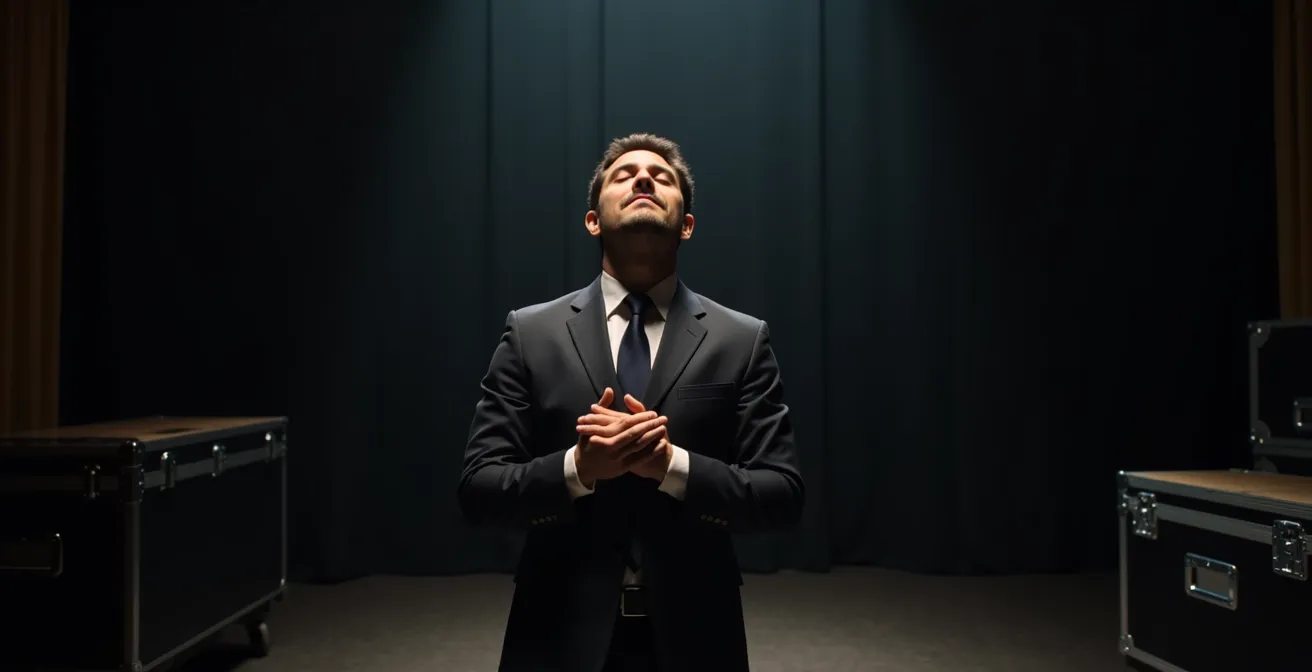
Your heart pounds against your ribs, your palms are slick with sweat, and your mind is a chaotic whirlwind of “what ifs.” You’re standing backstage, in a boardroom, or even just waiting for your turn on a video call. You’re safe, yet your body is screaming “DANGER!” This intense physical reaction to public speaking is incredibly common, but the typical advice often falls flat. You’ve been told to “practice more,” “picture the audience in their underwear,” or “just take a deep breath,” yet the physical tsunami of anxiety arrives right on schedule.
This experience is frustrating and can feel like a personal failing. But what if the key wasn’t about more practice or silly visualizations? What if the secret to calm lies not in ignoring your body, but in understanding its language and learning how to respond? This is the core principle of Cognitive Behavioral Therapy (CBT): recognizing that our thoughts, feelings, and physical sensations are all connected. The physical symptoms aren’t random; they are the result of a physiological hijack by your autonomic nervous system.
Instead of fighting this system, this guide will equip you with a toolkit of evidence-based ‘physiological levers’ you can pull to actively regulate it. We will move beyond platitudes and explore why your body panics, how to ground yourself in the moment, and how to use specific, science-backed techniques to release tension and quiet your mind. You will learn to work *with* your body, not against it, to regain a sense of control and deliver your message with confidence.
This article will walk you through the mechanics of your body’s anxiety response and provide a series of practical, actionable tools. By understanding the ‘why’ behind each technique, you’ll build not just a coping strategy, but true resilience.
Summary: A Toolkit for Mastering Pre-Speech Physical Anxiety
- Why Your Body Panics in Safe Situations Like Grocery Shopping?
- How to Use the “5-4-3-2-1” Technique to Stop a Panic Attack?
- Weighted Blankets or Noise-Canceling Headphones: Which Soothes Sensory Overload?
- The Coffee Mistake That Mimics a Panic Attack
- Problem & Solution: Quieting the “Racing Thoughts” Before Bed
- Why Stretching Doesn’t Release Tight Muscles Caused by Stress?
- Why Having Thoughts During Meditation Is Not a Sign of Failure?
- How to Meditate When You Have a “Monkey Mind” That Won’t Shut Up?
Why Your Body Panics in Safe Situations Like Grocery Shopping?
That sudden wave of panic you feel before a presentation—or even in a seemingly safe place like a grocery store—is not an overreaction; it’s a misinterpretation. Your autonomic nervous system, the body’s ancient survival mechanism, has mistakenly identified a non-lethal threat (social judgment, making a mistake) as a life-or-death predator. This “physiological hijack” is incredibly common; research shows that up to 75% of the population experiences some fear of public speaking. When this happens, your body enters a Sympathetic activation state: your heart races, muscles tense, and you feel an urge to flee. It’s preparing you to fight or run, not to deliver a quarterly report.
The first step to regaining control is not to fight this feeling, but to identify it. Your nervous system has three primary states. The goal state is the Ventral Vagal state, where you feel safe, connected, and socially engaged. The panic state is the Sympathetic state. And if the threat feels inescapable, you might fall into a Dorsal Vagal shutdown, feeling numb, disconnected, or mentally blank. Learning to recognize which state you’re in is the first step toward consciously shifting back to a state of safety and calm. You can’t steer a ship if you don’t know where it is.
By simply naming your state—”Okay, my heart is racing, this is sympathetic activation”—you create psychological distance. You are not your anxiety; you are an observer of your body’s response. This simple act of identification is the foundation of nervous system regulation and the first tool in your CBT toolkit. It transforms you from a passenger on a runaway train to the engineer who knows where the brakes are.
How to Use the “5-4-3-2-1” Technique to Stop a Panic Attack?
When your mind is racing and your body is in full sympathetic activation, trying to “think” your way out of it is like trying to reason with a smoke alarm. Your thinking brain (prefrontal cortex) is offline. To regain control, you need to use a “bottom-up” approach: calming your body to calm your mind. The 5-4-3-2-1 Grounding Technique is a powerful tool for this because it forces your brain to focus on the present sensory environment, interrupting the panic loop.
Here’s how it works. Pause and, wherever you are, name:
- 5 things you can see (the texture of the wall, a color on your screen, a crack in the floor).
- 4 things you can feel (your feet on the ground, the fabric of your shirt, the cool surface of a table).
- 3 things you can hear (the hum of a computer, a distant siren, your own breathing).
- 2 things you can smell (the coffee in your mug, the soap on your hands).
- 1 thing you can taste (the lingering taste of toothpaste, a sip of water).
This technique works by pulling your attention away from internal catastrophic thoughts and anchoring it in the neutral reality of your immediate surroundings. It’s a form of sensory grounding that tells your nervous system, “See? Nothing here is actually trying to eat me.”

Another incredibly effective, science-backed method is controlled breathing. A Stanford study highlighted the power of “Cyclic Sighing.” Researchers found participants who practiced this for just 5 minutes daily showed the greatest mood improvement and a significant reduction in respiratory rate. This technique is more effective than simple deep breathing because the double inhale fully inflates the tiny air sacs in your lungs (alveoli), and the long exhale off-loads more carbon dioxide, signaling profound calm to your brainstem.
Weighted Blankets or Noise-Canceling Headphones: Which Soothes Sensory Overload?
While tools like weighted blankets and noise-canceling headphones are excellent for creating a calming environment at home, they are impractical for the minutes leading up to a presentation. The good news is that the principles they use—deep pressure and sensory filtering—can be replicated with portable techniques you can do anywhere, anytime, without anyone noticing. The goal is to provide your nervous system with strong, calming proprioceptive (sense of body position) and sensory input to override the noise of anxiety.
You can create your own sensory toolkit by understanding the portable alternatives to these traditional tools. Instead of a weighted blanket, you can generate deep pressure yourself. Instead of blocking out sound, you can redirect your auditory focus. This empowers you to manage sensory overload discreetly and effectively, no matter the environment.
This table from Physio-pedia outlines how to translate the benefits of traditional tools into portable, discreet actions you can use moments before you speak.
| Traditional Tool | Portable Alternative | How It Works |
|---|---|---|
| Weighted Blanket | Firm foot pressure into floor | Proprioceptive input activates calming response |
| Noise-Canceling Headphones | Focus on 5 ambient sounds | Competing sensory channels reduce internal focus |
| Stress Ball | Palm-to-palm pressure (10 seconds) | Isometric contraction releases muscle tension |
Your Pre-Speech Sensory Cocoon Protocol
- Find a quiet corner backstage or in a restroom.
- Press your feet firmly into the ground for 30 seconds, feeling the connection with the floor.
- Push your palms together hard at chest level for 10 seconds, then release. Repeat this 3 times to feel the muscle tension and release.
- If you have one, hold a cold water bottle against your wrists or the back of your neck to activate the mammalian dive reflex.
- Focus intently on a single sensory detail, like the texture of your jacket sleeve or a small object in your pocket.
The Coffee Mistake That Mimics a Panic Attack
You’ve practiced your speech, you have your grounding techniques ready, but you make one critical mistake: you down a large coffee an hour before you’re on. Soon, your heart is racing, your hands are jittery, and your mind is buzzing. Is it anxiety, or is it the caffeine? The answer is both. Caffeine is a central nervous system stimulant that triggers the release of adrenaline, the very same hormone that fuels your fight-or-flight response. For someone already prone to anxiety, a strong dose of caffeine can be like pouring gasoline on a smoldering fire, creating physical symptoms that are indistinguishable from a panic attack.
While preparation is a major factor—studies indicate that up to 90% of anxiety can stem from a lack of preparation—what you consume is the final, crucial piece of the puzzle. Avoiding stimulants is key, but so is avoiding hunger. An empty stomach can lead to low blood sugar, which also causes shakiness and lightheadedness, further mimicking anxiety. The goal is to maintain stable energy levels.
A strategic nutrition timeline can make a significant difference in your physiological state. This isn’t about a diet; it’s about providing your body with steady fuel that won’t spike your adrenaline or crash your blood sugar. Opt for complex carbohydrates and protein for sustained energy, and switch to calming, caffeine-free beverages as you get closer to your speaking time. Think of it as fueling a high-performance engine for stability, not a drag racer for a short, chaotic burst of speed.
Follow this timeline to keep your body calm and your energy stable:
- 2 hours before: A light meal with complex carbs and protein (e.g., oatmeal with nuts, a turkey sandwich on whole wheat).
- 90 minutes before: A small, easily digestible snack (e.g., a handful of almonds and an apple slice).
- 60 minutes before: Switch to room temperature water only. Cold water can be a shock to the system for some.
- 30 minutes before: If you need something soothing, opt for caffeine-free peppermint or chamomile tea.
- Avoid at all costs: Coffee, energy drinks, sugary sodas, candy, or skipping meals entirely.
Problem & Solution: Quieting the “Racing Thoughts” Before Bed
The night before a big speech is often when the “what if” spiral begins. You lie in bed, and your mind starts rehearsing everything that could go wrong. This rumination, or “racing thoughts,” isn’t just mentally exhausting; it triggers the release of stress hormones like cortisol, which keeps your body in a state of high alert and prevents restful sleep. Research indicates that approximately 40% of people with public speaking anxiety experience sleep disturbances, creating a vicious cycle: anxiety disrupts sleep, and sleep deprivation amplifies anxiety.
The solution is not to try and force the thoughts away, which often makes them stronger. Instead, you give them a designated time and place. This CBT technique is called “Worry Time.” It involves scheduling a brief, 10-15 minute period earlier in the evening to actively engage with your worries. You sit down with a notebook and externalize them.
The “Worry Time” Technique in Practice
Mental health professionals have found that scheduling ‘Worry Time’ is a highly effective intervention. By setting aside a dedicated 5-10 minutes to write down fears and potential action plans, speakers create crucial psychological distance from their anxieties. This act of “containing” the worry to a specific time and paper, rather than letting it run free in their minds all night, gives them a profound sense of control. Studies and clinical reports show this simple practice can reduce nighttime rumination by up to 50%.

During your scheduled Worry Time, divide a page into two columns. In the first, write down every single fear, no matter how irrational. In the second, brainstorm a concrete, actionable next step for each. “What if I forget my words?” becomes “I will bring a notecard with key bullet points.” By the time you get into bed, when a worry tries to pop up, you can gently tell yourself, “I’ve already dealt with you. Your time is over for today.” This creates a clear boundary that allows your mind to finally rest.
Why Stretching Doesn’t Release Tight Muscles Caused by Stress?
When you’re anxious, your shoulders creep up to your ears and your jaw clenches. This isn’t just in your head; your nervous system is flooding your body with adrenaline, preparing your muscles for intense action. The resulting tension is a form of “armor” your body creates. The common advice is to do some static stretching, but you might notice it provides only temporary relief, if any. That’s because the tension isn’t from overuse, like after a workout; it’s from a constant “on” signal from your brain.
Static stretching (holding a position for 20-30 seconds) can sometimes even increase the feeling of tightness because you’re pulling against muscles that are actively contracting. To truly release this neurologically-driven tension, you need a technique that completes the stress cycle. Your body was prepared for intense movement (fight or flight), so providing that movement is the key to signaling “all clear.” This is where dynamic movement and shaking come in.
Animals in the wild instinctively shake their bodies to release the surge of adrenaline after a stressful event. Humans can borrow this primal technique to discharge stored-up nervous energy. A short, vigorous shaking session helps to burn off excess adrenaline, loosen chronically tight muscles, and sends a powerful signal to your nervous system that the threat has passed and it’s safe to relax. It’s a way of physically completing the stress response that was initiated in your brain.
Action Plan: The Dynamic Shaking Protocol for Stress Release
- Points of contact: Find a private space. Stand with your feet hip-width apart, knees slightly bent.
- Collecte: Start by shaking your hands vigorously for 15 seconds as if you’re trying to flick water off them. Notice the existing tension in your arms.
- Cohérence: Let the shaking move up into your arms and allow your shoulders to bounce naturally. Keep your jaw and neck loose. Confront the urge to stay rigid.
- Mémorabilité/émotion: Now include your whole body. Bounce gently on the balls of your feet, letting the vibration travel up through your legs and torso. This feels silly, but it is uniquely effective.
- Plan d’intégration: Continue for 30-60 seconds. Then, stop completely. Stand still for a moment and notice the tingling sensation and the profound feeling of release. This is the new baseline of calm you’ll carry with you.
Why Having Thoughts During Meditation Is Not a Sign of Failure?
Many people try meditation to calm their anxiety, sit down, and within thirty seconds, their mind is flooded with to-do lists, worries, and random thoughts. The immediate conclusion is, “I’m failing at this. My mind is too busy to meditate.” This is the single biggest misconception about mindfulness. The goal of meditation is not to have an empty mind; the goal is to notice when your mind has wandered and gently bring it back. The “bringing back” is the exercise.
Your brain is a thought-generating machine; that’s its job. Expecting it to go silent is like expecting your heart to stop beating. The practice of mindfulness isn’t about stopping the thoughts; it’s about changing your relationship to them. You learn to observe them without getting swept away. Each time you notice your mind has drifted to a worry about your upcoming speech and you guide your attention back to the sensation of your breath, you are performing a successful repetition of the exercise.
As a leading Stanford neuroscientist explains, this process actively strengthens the parts of your brain responsible for focus and emotional regulation. It’s a workout for your attention. As Dr. Andrew Huberman at Stanford University has noted in his research on the subject:
Each time you notice your mind racing and bring it back to your breath, you are strengthening your attentional ‘muscle’.
– Dr. Andrew Huberman, Stanford Neuroscience Research on Meditation
So, when you sit to meditate and your mind is a chaotic “monkey mind,” don’t see it as a sign of failure. See it as an opportunity for a great workout. More thoughts simply mean more opportunities to practice noticing and returning. This reframe is crucial; it transforms meditation from a frustrating battle against your own mind into a compassionate and empowering practice of self-regulation.
Key Takeaways
- Anxiety is a physiological state driven by your nervous system, not a character flaw. It can be regulated.
- You can use “bottom-up” tools like sensory grounding (5-4-3-2-1) and specific breathing patterns (Physiological Sigh) to actively shift your body out of a panic state.
- Proactive cognitive routines, such as scheduling ‘Worry Time’, are essential for preventing the mental rumination that fuels physical symptoms.
How to Meditate When You Have a “Monkey Mind” That Won’t Shut Up?
You understand that meditation isn’t about having a blank mind, but your “monkey mind” is still chattering so loudly that focusing on the breath feels impossible. For a highly anxious mind, a simple instruction like “watch your breath” can be too subtle. The mind needs a more tangible anchor, a more explicit physiological task to perform. This is where the Physiological Sigh comes in as a form of active meditation.
As discovered by researchers at labs like Stanford, the Physiological Sigh is the fastest known way to voluntarily calm the body and mind. It’s something we do unconsciously when we’re falling asleep or sobbing—a natural reset button for the nervous system. You can trigger this response consciously at any time. It works by using a double inhale to pop open the millions of tiny air sacs (alveoli) in your lungs, allowing for a more efficient exchange of oxygen and, crucially, a more thorough off-loading of carbon dioxide on the long exhale. This rapid change in blood chemistry is detected by the brainstem, which immediately sends a calming signal throughout the body.
Instead of passively watching your breath, you are actively controlling it in a very specific way. This gives your monkey mind a clear, simple job to do, making it an ideal technique for those who struggle with traditional meditation. You only need to do it one to three times to feel an immediate and noticeable shift in your state of alertness and anxiety. It is, quite simply, a direct lever to your nervous system.
Here is the step-by-step protocol for this powerful technique:
- Take a deep inhale through your nose, filling your lungs most of the way.
- Without exhaling, add a second, shorter “sip” of air through the nose to expand your lungs completely.
- Exhale slowly and fully through your mouth, making the exhale significantly longer than the combined inhales.
- Repeat this 1-3 times whenever you feel anxiety rising, even while seated and waiting to speak.
Start by choosing one of these tools and practice it today—not just before a speech, but in any moment of rising stress. By doing so, you are not just coping with anxiety; you are actively training your nervous system for resilience and building a profound sense of self-mastery.