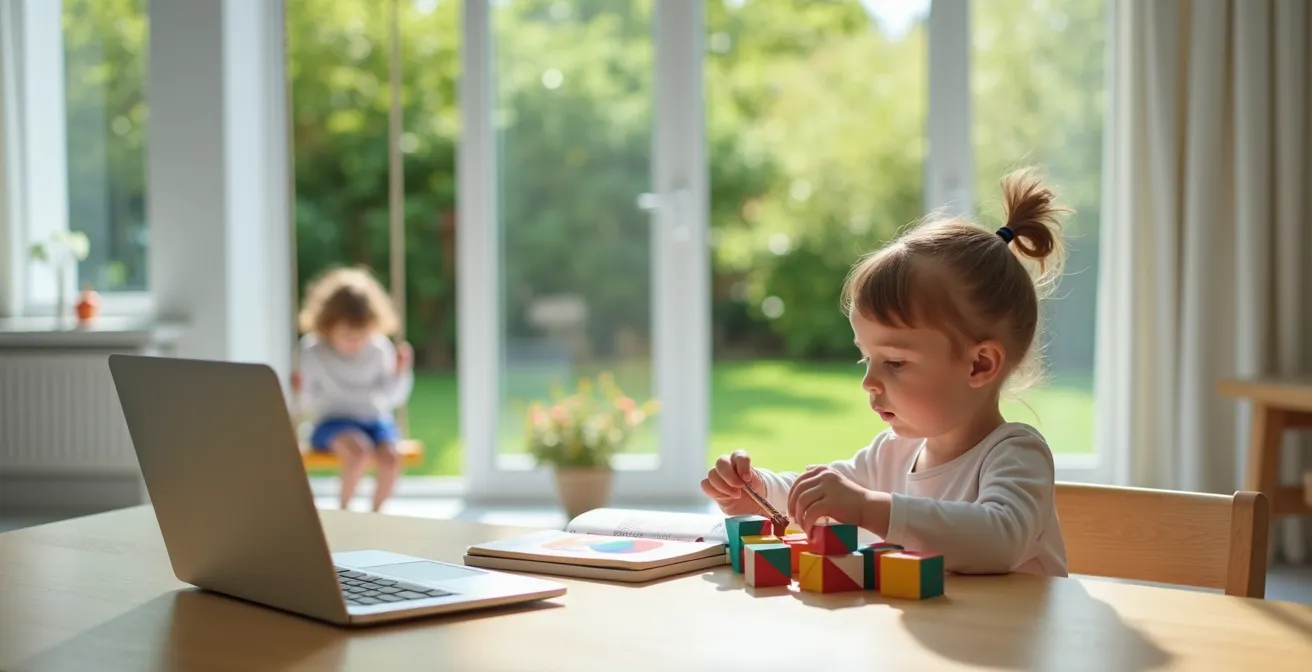
The key to balancing screen time isn’t just limiting hours; it’s about consciously rebuilding the entire developmental ecosystem that remote learning disrupts.
- Virtual interactions lack the multi-sensory feedback essential for young children’s social learning.
- A child’s well-being depends on a holistic balance of social rhythm, physical health, and emotional regulation, not just academic progress.
Recommendation: Shift your focus from managing screen time to architecting a rich, balanced daily life that nurtures your child’s mind, body, and social spirit.
As a parent navigating the world of remote schooling, you’ve likely asked yourself this question more than once: is my child becoming isolated? You see them diligently attending virtual classes, but a quiet worry persists. You’re not just concerned about the hours they spend in front of a screen, but what those hours are replacing. The spontaneous playground games, the whispers between classmates, the simple act of sharing a lunch table—these are the building blocks of social development.
The common advice often feels inadequate. You’re already setting limits, encouraging hobbies, and monitoring content. You might even be exploring different educational apps or scheduling family time. But these solutions feel like patches on a much larger issue. The real challenge isn’t just managing the digital world; it’s compensating for the loss of a physical one, an entire ecosystem of learning and growth that school traditionally provides.
But what if the solution wasn’t a battle against technology, but a more holistic reconstruction of your child’s world? The true key lies in understanding that screen time is just one piece of a larger puzzle. To nurture a socially adept and well-rounded child, we must look beyond the screen and focus on rebuilding their entire developmental ecosystem. This means consciously designing their days to support not just their academics, but their physical well-being, their natural energy rhythms, and their emotional intelligence.
This guide, framed from my perspective as a child development psychologist, will walk you through this holistic approach. We will explore why virtual interactions have limits, how to structure your child’s day for optimal energy, and how to choose activities that genuinely compensate for isolation. We will also address the crucial, often-overlooked physical and emotional components of this ecosystem, giving you a complete framework to help your child thrive.
To help you navigate these concepts, this article is structured to address the key pillars of your child’s developmental ecosystem. The following summary outlines the path we will take together to build a balanced and nurturing environment for your homeschooled child.
Summary: Nurturing a Balanced Developmental Ecosystem at Home
- Why Virtual Playdates Can’t Replace Physical Interaction for Under-10s?
- How to Create a Remote School Schedule That Mirrors Natural Energy Peaks?
- Team Sports or Art Clubs: Which Compensates Better for Remote Schooling Isolation?
- The Seating Error That Causes Chronic Neck Pain in Young Students
- When to Reintegrate: Signs Your Child Is Ready for a Hybrid Model
- Why Fresh Paint Smells Can Disrupt Your Deep Sleep Cycle?
- The “No Pain No Gain” Mistake That Blocks Somatic Healing
- How to Keep 30 Students Active in a Virtual Classroom Without Chaos?
Why Virtual Playdates Can’t Replace Physical Interaction for Under-10s?
As a parent, it’s natural to hope that a video call with a friend can fill the social void left by remote schooling. While it’s a valuable tool for connection, it’s crucial to understand its limitations, especially for children under ten. Real-world interaction is a rich, multi-sensory experience. It involves reading subtle body language, navigating personal space, sharing objects, and responding to unpredictable, in-the-moment cues. A virtual playdate flattens this experience into a two-dimensional exchange of faces and voices.
This is not just an intuitive feeling; it’s a documented phenomenon. Young children, in particular, learn social and motor skills through imitation and direct, physical feedback. They need to see how a friend’s whole body moves when they laugh, how they negotiate taking turns with a toy, or how they work together to build a fort. These are lessons that a screen simply cannot teach with the same fidelity.
Case Study: The “Video Deficit Effect” in Skill Development
Developmental research highlights a concept known as the “video deficit effect.” This shows that it can take children twice as long to learn a new action when it’s presented on a video compared to seeing it performed by an adult in person. In these studies, children often showed a lag in social skill development and struggled to reproduce the observed actions in a real-life setting, demonstrating that the translation from screen to reality is not automatic for young minds.
Therefore, the goal is not to eliminate virtual hangouts but to recognize them for what they are: a supplement, not a substitute. They maintain connections but do not build foundational social skills in the same way. The priority must remain on creating opportunities for tangible, embodied, and unscripted physical play, which forms the bedrock of your child’s social rhythm and emotional intelligence.
How to Create a Remote School Schedule That Mirrors Natural Energy Peaks?
One of the hidden challenges of remote schooling is the rigid, monotonous structure it can impose. A child who would naturally be running outside at 10 a.m. might be tethered to a screen for a math lesson. As a psychologist, I encourage parents to shift from being time managers to becoming energy architects. This means designing a daily schedule that works *with* your child’s natural biological rhythms, not against them.
Most children experience a peak of analytical energy and focus in the morning, making it an ideal time for core subjects like math or reading. The early afternoon often brings a dip, perfect for a long break, outdoor play, or quiet rest. Later in the afternoon, a second wave of more creative energy often emerges, which can be channeled into art, music, or project-based learning. By observing your child, you can map their unique pattern and build a flexible routine around it. This approach not only improves learning outcomes but also reduces frustration and resistance.

It’s also important to have an empathetic perspective on technology’s role. It’s not an enemy to be vanquished. As one analysis notes, it’s a key part of modern development.
Studies show that around 70% of young people view technology and the internet as being important to developing their independence. Teenagers, especially, view it as a key part of their developing lives.
– Stark Raving Dad Blog, Episode on Finding Balance With Screens
This table offers a general framework for screen time, which you can adapt to your child’s personal energy architecture. The goal is balance, not just restriction.
| Age Group | Recommended Daily Limit | Key Consideration |
|---|---|---|
| Under 2 years | No screen time | Critical period for sensory development |
| 2-5 years | 1 hour maximum | High-quality educational content only |
| 6-12 years | 1-2 hours | Balance with physical activity |
| 13+ years | Flexible with boundaries | Focus on content quality and sleep hygiene |
Team Sports or Art Clubs: Which Compensates Better for Remote Schooling Isolation?
When trying to compensate for the social isolation of remote school, many parents feel pressured to enroll their children in large group activities like team sports. The assumption is that more children equal more socialization. However, the most crucial factor isn’t the quantity of peers but the quality of the interactions. The best choice of activity depends entirely on your child’s temperament and what kind of social environment allows them to thrive.
Team sports are excellent for teaching collaboration, competition, and resilience in a structured, fast-paced environment. For an outgoing, energetic child, this can be a perfect fit. However, for a more introverted or sensitive child, a large team can be overwhelming. An art club, a book group, or a small coding class might offer a calmer setting where deep, one-on-one friendships can flourish over shared interests. In these environments, children learn to listen, share complex ideas, and build connections based on mutual passion, which are equally vital social skills.
It’s important to dispel the myth that homeschooled children are inherently at a social disadvantage. In fact, the opposite can be true when their social experiences are curated for quality.
Case Study: Quality of Friendships in Homeschooled Children
Contrary to popular concern, research has shown that homeschooled children are not necessarily lacking in social skills. For instance, research by Richard G. Medlin of Stetson University notes that students in a homeschool environment often develop higher quality friendships and build better relationships with their parents and other adults, likely due to more focused and meaningful interactions.
With children in the 8-12 age range spending a significant amount of time online, providing a deliberate, high-quality offline social outlet becomes paramount. Data shows that children aged 8-12 average 4-6 hours of screen time daily, making the choice of compensatory activities a critical part of their developmental ecosystem.
The Seating Error That Causes Chronic Neck Pain in Young Students
The shift to remote learning has moved the classroom to the kitchen table or the bedroom floor, and with it comes a host of physical challenges that are often overlooked. We, as parents and guardians, are rightly concerned about screen addiction; a survey revealed that 54% of parents feel their child is addicted to screens. But the physical impact is just as pressing. One of the most common yet correctable issues I see is poor ergonomics, leading to what is sometimes called “tech neck.”
The critical seating error is a screen positioned too low, forcing the child to constantly crane their neck downwards. A child’s head is heavy relative to their body, and holding this forward-leaning posture for hours puts immense strain on the cervical spine and surrounding muscles. This can lead to chronic neck pain, shoulder tension, and even headaches, creating a layer of physical discomfort that affects mood, concentration, and overall well-being. It’s a prime example of how the physical environment is a core pillar of your child’s developmental ecosystem.
Creating a proper ergonomic setup is not complicated or expensive, but it requires conscious effort. The goal is to create a workspace that encourages a neutral spine posture, where the ears are aligned with the shoulders. This is a foundational aspect of environmental hygiene that supports both physical health and the ability to learn effectively, free from the distraction of pain. Taking this seriously is as important as setting time limits on screens.
Action Plan: Your Ergonomic Setup Checklist
- Screen at Eye Level: Position the screen so the top is at or slightly below eye level to prevent neck strain and maintain a neutral posture. Use a stack of books or a monitor stand if needed.
- Supportive Seating: Use an adjustable chair that allows your child’s feet to rest flat on the floor or a footrest. Their knees should be at a 90-degree angle.
- Scheduled Movement: Implement 5-10 minute movement breaks every hour. This helps reset posture, reduces muscle strain, and provides a mental refresh.
- Designated Screen-Free Zones: Keep bedrooms as screen-free zones, especially in the evening, to protect sleep quality and create a clear boundary between rest and work.
- Dynamic Seating Options: For short periods, consider ‘dynamic seating’ like a stability ball or a standing desk to encourage micro-movements and active learning.
When to Reintegrate: Signs Your Child Is Ready for a Hybrid Model
For many families, full-time remote schooling is a temporary solution. The question of when and how to transition back to a hybrid or full-time in-person model is a significant one. There is no universal timeline; the right moment depends on observing your child’s unique cues. As their parent, you are the best-equipped person to notice the subtle signs that their developmental needs are shifting.
Look for changes in their behavior and emotional state. Is your child expressing more frequent feelings of loneliness or boredom, even when they have virtual connections available? Are they showing less interest in online activities that they once enjoyed? Increased irritability, a decline in energy, or difficulty maintaining virtual friendships can all be signals that their need for tangible, real-world social interaction is becoming more acute. These are not signs of failure, but rather healthy indicators that your child is ready for the next developmental step.

The transition itself should be gradual and supportive. Think of it as helping your child build back their “social stamina.” You can start with one structured in-person activity per week, like a library club or a sports practice. Observe how they handle it. Do they come home energized or exhausted? Are they forming connections? Based on their comfort and success, you can slowly increase the frequency and duration of these peer interactions, ensuring the process is empowering rather than overwhelming.
Why Fresh Paint Smells Can Disrupt Your Deep Sleep Cycle?
While a topic like fresh paint might seem unrelated to screen time, it highlights a crucial concept I call environmental hygiene: the idea that a child’s immediate physical surroundings have a profound impact on their physiological functions, especially sleep. The volatile organic compounds (VOCs) in fresh paint are known irritants that can affect the respiratory system and disrupt sleep. But in today’s digital world, the most pervasive environmental disruptor in your child’s bedroom isn’t paint—it’s the screen itself.
The blue light emitted from tablets, phones, and computers is a powerful environmental signal to the brain. It mimics daylight and actively suppresses the production of melatonin, the hormone that regulates our sleep-wake cycles. When a child is exposed to screens in the evening, their brain receives the message that it’s still daytime, making it difficult to fall asleep, stay asleep, and reach the deep, restorative stages of sleep necessary for learning, memory consolidation, and emotional regulation.
The blue light emitted by screens can interfere with melatonin production, the hormone responsible for regulating sleep. This can lead to difficulties falling asleep, disrupted sleep patterns, and overall sleep deprivation.
– Life Guard Pediatric, Screen Time for Kids: Balance Digital Life and Healthy Development
This sleep disruption is not a minor issue; it’s a significant health concern. Research confirms the link, showing that even among very young children, screen use is tied to sleep problems. For instance, a study found that 6- to 36-month-old children with high touchscreen use showed increased sleep difficulties. For school-aged children, whose brains are undergoing critical development, protecting sleep is non-negotiable. Establishing a strict “no screens in the bedroom” rule is one of the most effective strategies a parent can implement to improve their child’s overall well-being.
The “No Pain No Gain” Mistake That Blocks Somatic Healing
In our achievement-oriented culture, we often apply a “no pain, no gain” mentality to challenges. We encourage our children to “push through” difficulties. While this can build resilience, it becomes harmful when applied to social and emotional development. Forcing a socially anxious child into overwhelming situations or ignoring the physical signs of screen fatigue is a mistake that blocks what psychologists call somatic healing—the process of listening to and honoring the body’s signals.
Your child’s body communicates its needs constantly. A stomachache before a virtual call, fidgeting after an hour of screen time, or sudden irritability are not just “bad behaviors”; they are signals of a nervous system that is overwhelmed. Pushing them to “just deal with it” teaches them to ignore their own somatic intelligence. This can hinder their ability to develop self-regulation and emotional awareness, which are critical skills. Studies on adolescent development confirm that real-world interactions are essential for this growth, and that excessive screen time can significantly hinder teens’ social and emotional development by replacing these vital experiences.
Instead of pushing through, the goal is to build social and emotional stamina gradually. This involves creating experiences that are challenging but not overwhelming, and teaching your child to recognize and respond to their body’s cues. This empathetic approach fosters trust and empowers them to manage their own energy and emotions, a far more valuable skill than simply enduring discomfort.
Here are some gentle strategies for building social stamina without causing overwhelm:
- Start with structured movement bursts between screen sessions to reset the nervous system.
- Practice active listening skills during phone-free mealtimes with family.
- Give specific, positive feedback about social behaviors to help them become more automatic.
- Teach self-soothing techniques like focused breathing and mindfulness to manage anxiety.
- Allow your child to teach you about their interests to build their confidence and communication skills.
Key Takeaways
- True social development for kids under 10 happens through physical, multi-sensory interaction that screens cannot replicate.
- Structuring your child’s day around their natural energy peaks (energy architecture) is more effective than enforcing rigid time blocks.
- A healthy developmental ecosystem requires a holistic approach, balancing social needs with physical ergonomics and environmental factors like sleep hygiene.
How to Keep 30 Students Active in a Virtual Classroom Without Chaos?
The challenge of keeping a large class of 30 students engaged in a virtual setting might seem like a teacher’s problem, but it holds powerful lessons for parents of a single homeschooled child. The principles that expert educators use to prevent chaos and maintain focus can be scaled down and applied to create a more dynamic and engaging learning day at home. The core lesson is this: the key is not to fight for attention, but to channel energy constructively.
Teachers in virtual classrooms learn quickly that long, passive lectures are a recipe for disengagement. Instead, they break lessons into short, 15-20 minute chunks, alternating between focused instruction, interactive activities, and physical movement breaks. They might use a quick poll, a virtual breakout room for a paired task, or a “stand up and stretch” command. This same principle of variety is your most powerful tool at home. By alternating between different types of tasks, you prevent mental fatigue and cater to a child’s natural need for movement.
A crucial distinction to make is between active and passive screen time. Watching a video is passive, while participating in an interactive coding lesson or creating digital art is active. The goal is to maximize active, creative, and collaborative screen use while minimizing passive consumption. This framework helps you evaluate the quality of your child’s digital diet, not just the quantity.
This table can help you differentiate between activities and prioritize those that offer the most developmental benefits.
| Activity Type | Engagement Level | Developmental Benefit |
|---|---|---|
| Interactive Educational Games | High | Problem-solving, collaboration |
| Creative Content Creation | High | Self-expression, technical skills |
| Passive Video Watching | Low | Limited cognitive engagement |
| Virtual Movement Activities | High | Physical coordination, energy release |
By applying these principles, you shift from being a supervisor to being a facilitator of a dynamic and engaging learning environment. You are the architect of your child’s developmental ecosystem, and you have the power to build one that is balanced, nurturing, and perfectly suited to help them thrive, both on and off the screen.
Frequently Asked Questions About Homeschooling and Screen Time
What are signs my child needs more in-person social interaction?
Look for decreased interest in online activities they once enjoyed, new difficulties in maintaining friendships, increased irritability or frustration, or directly expressing feelings of loneliness despite having virtual connections.
How can I gradually transition to a hybrid model?
The key is a slow and observant approach. Start with one structured, in-person activity per week. Carefully monitor your child’s energy levels and social stamina afterward. Then, you can gradually increase the frequency or duration based on their comfort and success with these new peer interactions.
How much screen time is typical for homeschooled children?
General studies show that watching video content alone accounts for about 2 hours and 40 minutes daily for tweens (ages 8-12). If your child is using an online curriculum for homeschooling, you are likely adding at least a couple more hours of academic screen time to that equation, making it crucial to balance this with offline activities.