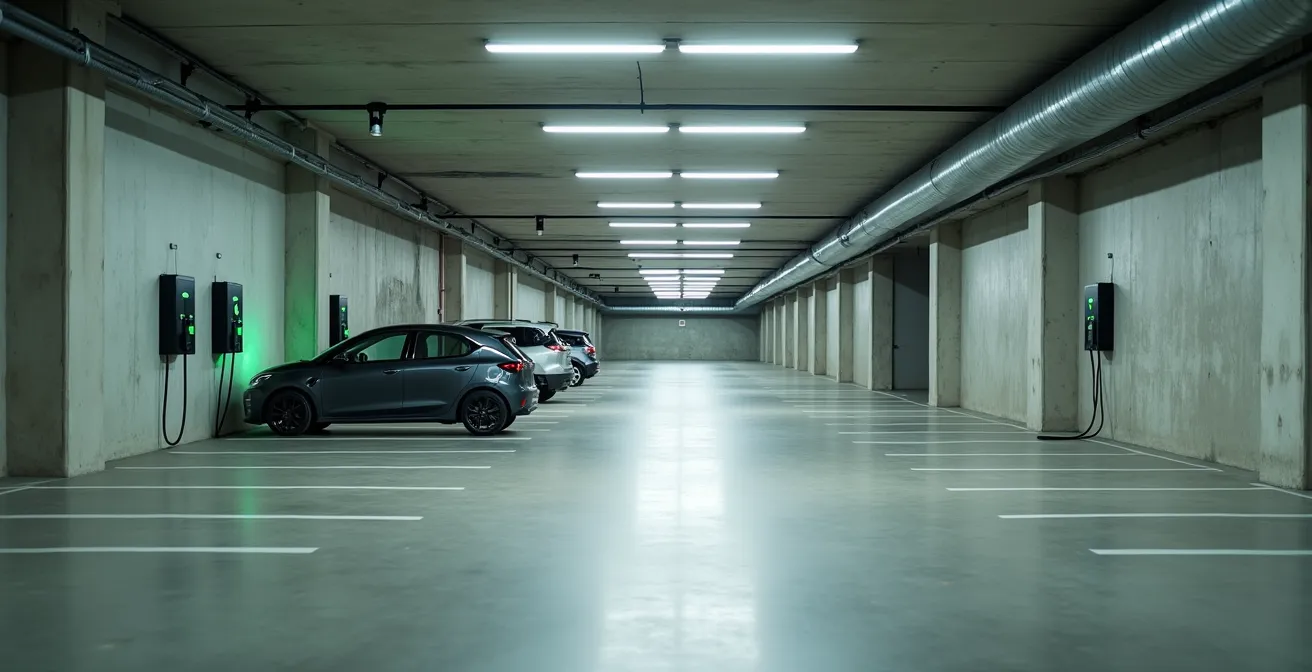
Contrary to a condo board’s initial belief, approving EV charging is not an optional amenity expense; it is a critical act of risk mitigation and fiduciary duty.
- The existence of “Right-to-Charge” laws in many states transforms a board’s refusal from a simple “no” into a significant legal liability.
- Engineered solutions like sub-metering, load management, and third-party ownership models effectively neutralize the board’s primary objections regarding cost and electrical capacity.
Recommendation: Reframe your proposal from a resident’s request into a consultant’s brief on legal compliance, future-proofing, and financial risk avoidance.
For an electric vehicle owner in a condominium, the board’s rejection of a charging station proposal can feel like an insurmountable roadblock. The typical objections are predictable: concerns over electricity costs, questions of liability, and the fear of overloading the building’s aging electrical infrastructure. Many residents attempt to persuade their boards by highlighting increased property values or environmental benefits, arguments that often fail to address the board’s core concerns rooted in financial and legal risk.
This approach is fundamentally flawed. The conversation should not be a plea for a modern convenience. It must be a formal, evidence-based presentation that repositions the board’s refusal as a failure of its fiduciary duty and a direct exposure to legal and financial liability. The key is to shift your role from that of a petitioner to that of a pro-bono risk management advisor, guiding the association toward a decision that is not only necessary but legally prudent and financially sound.
This guide provides the legal, technical, and financial framework to build that case. We will dissect each common objection and arm you with the specific statutes, engineering principles, and funding models required to dismantle it. You will learn to demonstrate that inaction is far more costly and risky than a well-planned, forward-thinking EV infrastructure strategy.
Summary: A Legal & Financial Guide to EV Charger Approval in Your Condo
- Why Your HOA Cannot Legally Ban EV Chargers in Some States?
- How to Bill Electricity Usage to Specific Parking Spots Without Smart Meters?
- Level 1 or Level 2:How to Optimize Bus Routes Using AI Without Disrupting Daily Commuters?
- The Load Calculation Mistake That Blows the Main Building Fuse
- Problem & Solution: Funding the Installation With Government EV Grants
- Co-op or LLC: Which Structure Protects Members From Liability?
- The Infrastructure Mistake That Costs Early Adopters $50,000 in Year One
- How to Legally Form a Neighborhood Microgrid to Share Solar Power?
Why Your HOA Cannot Legally Ban EV Chargers in Some States?
The foundational element of your proposal is not a request, but an assertion of rights. Many Homeowners Associations (HOAs) and condo boards operate under the mistaken belief that they have absolute authority to deny any modification to common or private elements. However, in the context of EV charging, this authority is increasingly curtailed by state-level legislation. These “Right-to-Charge” laws are your most powerful tool, transforming the conversation from one of permission to one of legal compliance.
For instance, an analysis of state regulations shows that legal protection already exists in nine states, including California, Colorado, and Florida. California’s Civil Code Section 4745 is a prime example, specifically preventing an HOA from unreasonably denying a resident’s request to install a personal EV charger. The law astutely places the burden of all costs—installation, maintenance, and electricity—as well as all associated liability, squarely on the EV-owning resident. This structure effectively nullifies the board’s primary financial and legal objections, making approval a low-risk, legally mandated decision.
Your presentation to the board must begin here. You are not asking for a favor; you are informing them of their statutory obligations. Framing the issue as a matter of compliance with existing law, rather than an amenity request, puts the board on notice. Denying a request in a Right-to-Charge state exposes the association to legal challenges, potential fines, and legal fees—a clear violation of their fiduciary duty to protect the association’s assets.
Your Action Plan for a Legally Sound Proposal
- Research your state’s specific “Right-to-Charge” laws and document the exact legal statute to present to the board.
- Collect all necessary documentation, such as contractor licenses and insurance certificates, as required by the statute.
- Frame your proposal as an opportunity for the board to establish a clear, compliant policy for all future EV charger requests, demonstrating leadership.
- Emphasize that under most statutes, the owner (you) bears all installation costs, ongoing electricity usage, and liability, insulating the association from risk.
- Create a compliance timeline, showing that while your request is the first, many more will follow, making a proactive policy essential.
How to Bill Electricity Usage to Specific Parking Spots Without Smart Meters?
After the legal argument, the most common and immediate objection is financial: “Who pays for the electricity?” The board’s fear is that common area electricity bills will skyrocket, forcing a special assessment on all residents, including those without EVs. This is a valid concern that must be addressed with a clear, technically sound, and fair solution: sub-metering. A proposal that does not definitively solve the billing issue is incomplete and destined for rejection.
Sub-metering involves installing a dedicated electricity meter for the circuit that powers the EV charger. This device measures the exact amount of electricity consumed by a specific charger and allows it to be billed directly to the owner of that parking spot. This is not new or experimental technology; it is the standard, utility-approved method for assigning electrical costs in multi-tenant commercial and residential buildings. While initial installation costs typically range from $2,000 to over $10,000 for a Level 2 charger, your proposal must state explicitly that this cost, including the sub-meter, is borne entirely by you, the resident.
Presenting a sub-metering solution demonstrates that you have thoroughly considered the financial impact on the community and are proposing a system that is equitable to all. It proves that no other resident will subsidize your transportation fuel costs. This preemptively disarms the “fairness” argument and shows the board that a clean, auditable mechanism for cost allocation exists.
This paragraph introduces the concept of sub-metering. To better understand this crucial component, the image below illustrates a typical sub-meter installation in a parking garage environment, separating a specific spot’s usage from the building’s main electrical system.
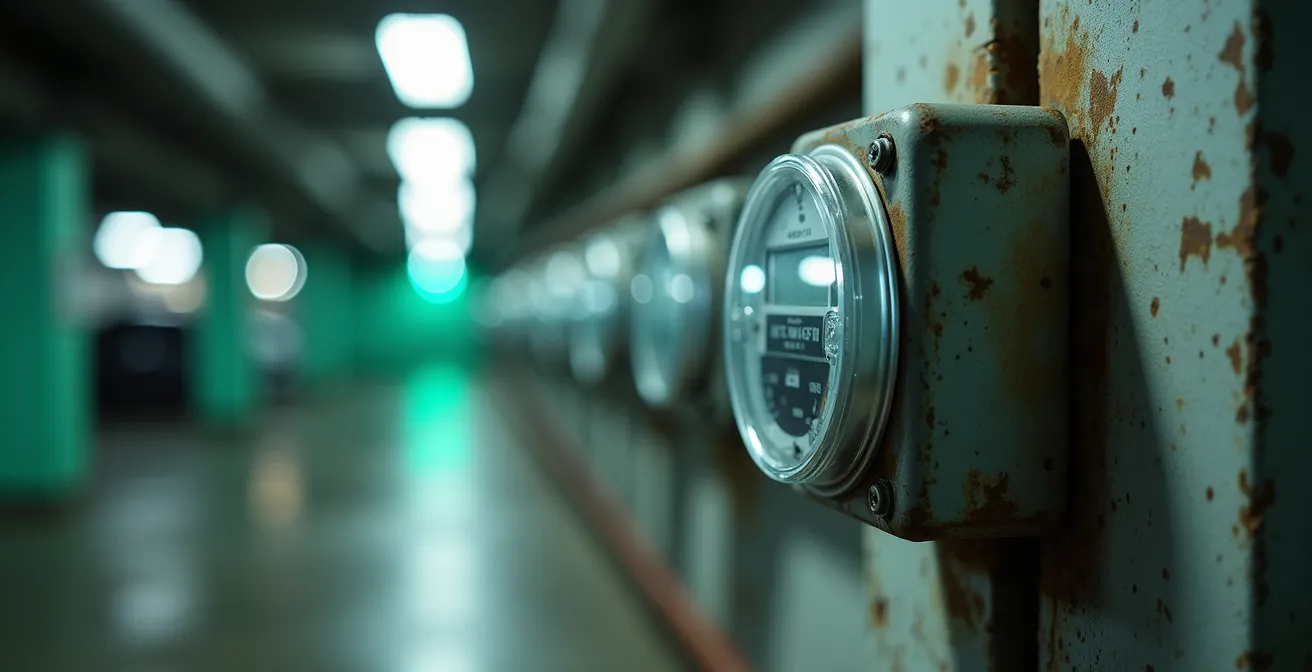
As this image demonstrates, the sub-meter is a discrete piece of hardware that integrates cleanly into the existing infrastructure. Your proposal should include a quote from a licensed electrician that specifies the installation of such a sub-meter, thereby providing the board with a tangible, professional solution to their billing concerns. This moves the conversation from a vague problem to a concrete, solvable engineering task.
Level 1 or Level 2:How to Optimize Bus Routes Using AI Without Disrupting Daily Commuters?
Just as artificial intelligence can optimize complex systems like bus routes to serve the most commuters without causing disruption, a strategic EV charging plan optimizes power delivery without disrupting the building’s electrical ecosystem. The first major decision in this optimization is choosing the right “vehicle” for the job: Level 1 or Level 2 chargers. Presenting a phased rollout strategy that begins with lower-impact options can be a highly persuasive tactic to overcome initial cost and capacity concerns.
Level 1 charging uses a standard 120V outlet, the same kind you find throughout your home. It’s slow, adding only 2-5 miles of range per hour, but it is often sufficient for residents who drive moderately and can charge overnight for 8-12 hours. The electrical draw is minimal, roughly equivalent to a refrigerator, and in many cases, it can be supported by existing circuits with little to no modification. Proposing a Level 1-only “Phase 1” can be a low-cost, low-risk entry point for a hesitant board.
Level 2 charging, which uses a 240V circuit similar to an electric dryer, is the more robust solution. It can add up to 37 miles of range per hour, making it ideal for residents with longer commutes or a need for faster top-ups. While the installation is more involved, your proposal can frame this as a future phase. A smart strategy is to install the necessary infrastructure, such as larger 4-inch conduit, during Phase 1. This “pre-wiring” makes the eventual upgrade to Level 2 significantly cheaper and less disruptive, showing the board you have a long-term, cost-effective plan.
By presenting a phased approach, you demonstrate financial prudence and an understanding of the need to scale with demand. You can propose starting with a few dedicated Level 1 spots and shared Level 2 chargers in common areas, all managed by a dynamic load balancing system. This system, which acts like an AI traffic controller for electricity, ensures the building’s total capacity is never exceeded, addressing the board’s technical fears head-on.
The Load Calculation Mistake That Blows the Main Building Fuse
The board’s most significant technical objection will likely be a fear of overloading the building’s main electrical service, leading to blown fuses or catastrophic failure. This concern is often born from a common amateur mistake: the “Static Sum Fallacy.” This is the simplistic assumption that the total electrical load is the sum of the maximum possible draw of all chargers operating simultaneously. Your role as an advisor is to introduce them to the professional engineering principle that refutes this: the Diversity Factor.
A professional electrical engineer never assumes all devices will run at 100% capacity at the same time. Instead, they apply a diversity factor based on the realistic expectation that usage will be staggered. Modern, network-connected EV chargers enhance this principle. They can communicate with each other and a central controller to manage and schedule charging sessions, ensuring the building’s total demand stays within safe limits. This is known as Dynamic Load Management (DLM) or Demand Control. It measures the building’s real-time capacity and automatically throttles or pauses vehicle charging if an essential service, like an elevator, demands power.
The typical electrical requirements show that single-phase chargers demand around 32 amps, a significant load. However, a DLM system ensures that even with ten chargers installed, the total draw never exceeds a pre-set, safe threshold on the main panel. This is the critical point to make: a professionally designed system does not create risk; it actively manages and mitigates it. Your proposal must insist on a formal load calculation performed by a licensed electrical engineer who understands these principles, and it must specify the inclusion of a DLM system.
The building’s main electrical service panel is the heart of the system. Visualizing this core infrastructure helps the board understand what is being protected. The image below shows a main electrical room where capacity is assessed and managed.
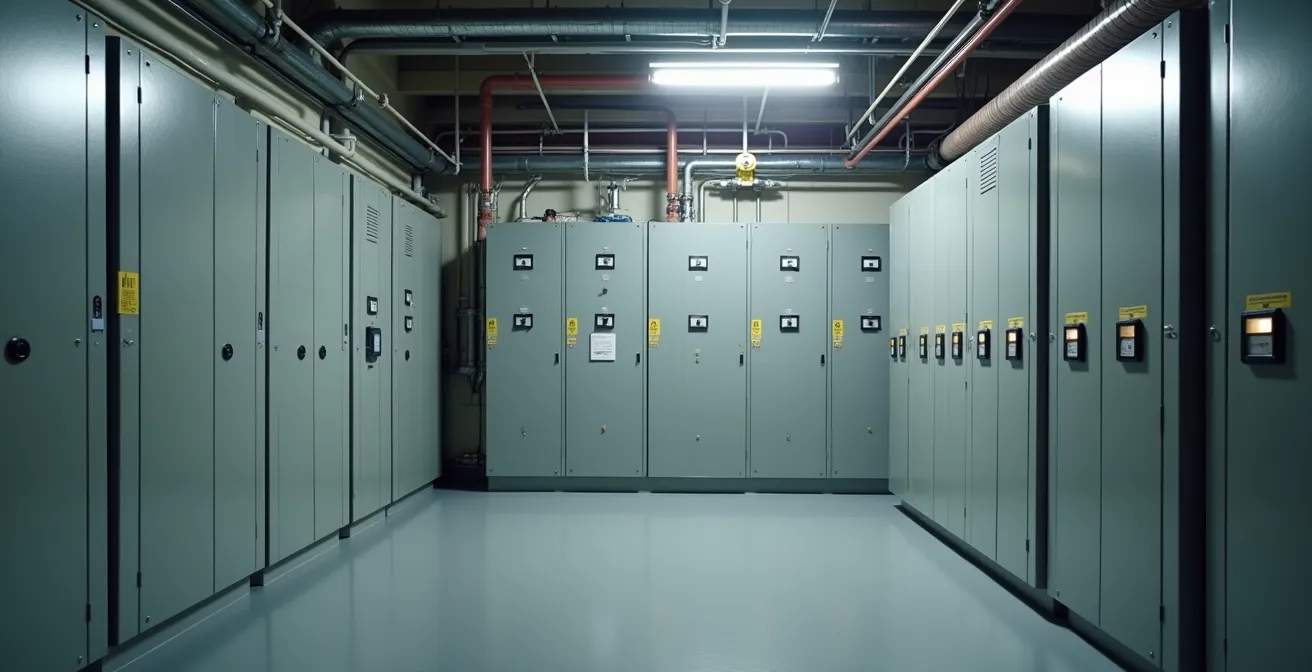
By showing respect for this central system and presenting an engineered solution to protect it, you replace the board’s fear with confidence. You are not proposing a reckless addition; you are proposing a smart, managed, and fail-safe upgrade that respects the building’s operational limits while preparing it for the future.
Problem & Solution: Funding the Installation With Government EV Grants
Even with legal pressure and technical solutions, the upfront cost remains a significant psychological barrier for a condo board. The most effective way to eliminate this final hurdle is to present a comprehensive funding strategy that dramatically reduces or even eliminates the cost to the association. This involves strategically leveraging a combination of federal, state, and utility-level incentives designed specifically to promote EV infrastructure.
The cornerstone of this strategy is the federal Alternative Fuel Vehicle Refueling Property Credit (30C). For projects in qualifying low-income or non-urban census tracts, federal incentives currently offer a 30% tax credit up to $1,000 for residential installations and, crucially for an HOA, up to $100,000 for commercial-grade installations. The deadline of June 30, 2026, adds a powerful sense of urgency that you must emphasize. Your first step should be to use the official IRS 30C Tax Credit Eligibility Locator to verify if your building qualifies, a key piece of data for your proposal.
As one industry analysis in the Guide to EV Charging Grant Applications correctly states:
The biggest mistake is designing a project and then looking for money. The strategy is to find available grants first and then tailor the project proposal to meet the grant’s specific criteria.
– Industry Analysis, Guide to EV Charging Grant Applications
Beyond the federal level, a patchwork of state and local utility programs can be “stacked” on top of the 30C credit to cover a majority of the project cost. These programs are numerous and vary widely, requiring diligent research. Presenting the board with a clear table of potential funding sources transforms the project from an “unfunded mandate” into a “heavily subsidized upgrade.”
The following table illustrates how different incentives can be combined to maximize funding. It is imperative to research the specific programs available in your state and for your local utility provider to create a customized version for your proposal.
| Incentive Type | Amount | Eligibility | Deadline | Stackable |
|---|---|---|---|---|
| Federal 30C Tax Credit | 30% up to $100,000 (commercial) | Qualifying census tracts | June 30, 2026 | Yes |
| Colorado Xcel Energy | Up to $1,300 | Residential customers | Ongoing | Yes |
| California Utility Rebates | Varies by utility | Service territory residents | Check utility | Yes |
| State EV Infrastructure Grants | 50-80% of project cost | Multi-unit dwellings | Varies | Usually |
Co-op or LLC: Which Structure Protects Members From Liability?
The final pillar of a board’s resistance is liability. “What happens if a charger malfunctions and causes a fire? Who is responsible if someone trips over a cable?” These are legitimate concerns that fall squarely within the board’s fiduciary duty to protect the association. Your proposal must proactively present legal and operational structures that insulate the HOA from all liability, shifting the risk to other parties.
One powerful option is the creation of a separate legal entity, such as an “EV Charging LLC,” formed by the interested residents. This LLC would raise its own capital, own the charging equipment, and carry its own insurance policy. The HOA simply grants an easement or license for the equipment to be on the property. In this model, any liability is contained within the LLC, legally shielding the HOA’s general funds and all other residents. This requires more organization but offers the cleanest separation of risk.
An even more compelling solution for a risk-averse board is the Third-Party Ownership model, often called Charging-as-a-Service (CaaS). In this scenario, a specialized company installs, owns, and maintains the charging equipment at zero upfront cost to the HOA. The CaaS provider assumes all liability, manages billing, and handles all customer service. The HOA’s only role is to sign a long-term contract granting them space. Residents who wish to use the service typically pay the CaaS provider a one-time access fee or a monthly subscription. For a board, this is the ultimate low-risk proposition: all the benefits of an EV-ready building with none of the financial or legal burden.
The following table compares the different ownership structures you can present to your board, clearly highlighting how risk and management burden can be shifted away from the association.
| Structure | Upfront Cost | Liability | Control | Management Burden |
|---|---|---|---|---|
| EV Charging LLC | Member-funded | Isolated to LLC | High (member-controlled) | Medium |
| Internal Co-op | Special assessment | Shared by HOA | High (board-controlled) | High |
| Third-Party Operator | $0 | None to HOA | Low | Minimal |
| Individual Owner Install | Owner bears all | Individual only | Individual | None to HOA |
Key Takeaways
- Frame your request as a legal compliance issue, not an amenity, by leveraging state “Right-to-Charge” laws where applicable.
- Solve the cost problem with concrete solutions: sub-metering for fair billing, government grants to fund installation, and third-party ownership to eliminate HOA cost entirely.
- Neutralize technical fears by insisting on a professional load calculation that uses Diversity Factor and specifying a Dynamic Load Management (DLM) system.
The Infrastructure Mistake That Costs Early Adopters $50,000 in Year One
After addressing the board’s immediate objections, the final persuasive element is to reframe their decision in terms of long-term cost avoidance. The most significant financial risk is not the cost of installing chargers today, but the exponentially higher cost of retrofitting a building that was not planned for the future. Presenting a “do it right the first time” argument appeals directly to the board’s fiduciary duty to make prudent financial decisions for the community.
The single most expensive mistake is failing to plan for future capacity. This often involves installing electrical conduit that is too small to accommodate more than one or two chargers. When the third, fourth, and tenth residents request chargers, the association is forced to undertake expensive and disruptive work to run new, larger conduit. However, proper planning demonstrates that installing stub-outs for future chargers… saves 50-70% versus retrofitting each spot individually later. Your proposal should advocate for installing a large-diameter (e.g., 4-inch) main conduit run from the electrical room to the parking garage as part of the initial project, even if only one charger is being installed immediately.
Other critical, costly mistakes to highlight include:
- Choosing Proprietary Systems: Locking the building into a single hardware vendor (a “closed” system) prevents competitive pricing and future technology upgrades. Your proposal must mandate Open Charge Point Protocol (OCPP)-compliant hardware, which ensures interoperability between different brands.
- Overlooking Demand Charges: Many commercial electricity bills include “demand charges” based on the peak power used in a given month. A single, unmanaged charging session at the wrong time could trigger thousands of dollars in fees. This underscores the necessity of a Dynamic Load Management system from day one.
- Ignoring ADA Compliance: Failing to plan for accessible charging stations for residents with disabilities can lead to costly retrofits and potential legal action. Designating compliant locations early is a crucial part of a responsible plan.
By outlining these potential financial landmines, you shift the narrative. The upfront investment in a well-planned, scalable infrastructure is not an expense; it is insurance against massive future special assessments. It is the financially responsible choice.
How to Legally Form a Neighborhood Microgrid to Share Solar Power?
The final component of your persuasive argument is to elevate the board’s perspective beyond the immediate problem. Installing EV charging infrastructure is not merely about fueling cars; it is the foundational first step in transforming your building into a future-ready energy asset. This positions the board’s decision not as a reluctant concession, but as an act of profound strategic foresight, setting the stage for future revenue generation and energy resilience, potentially leading to a neighborhood microgrid.
The key to this vision is bidirectional charging technology. While current chargers are unidirectional (grid-to-vehicle), the next generation of hardware will be bidirectional, allowing energy to flow from car batteries back into the building. This is known as Vehicle-to-Building (V2B). By approving a robust, professionally installed charging infrastructure today, the board is making the building “battery-ready” for tomorrow. When V2B becomes mainstream, the combined batteries of all the EVs in the garage can act as a single, massive power bank for the entire building.
This capability unlocks several transformative possibilities:
- Peak Shaving: The building can draw power from the residents’ car batteries during periods of peak electricity demand when utility rates are highest, dramatically lowering its operational costs.
- Energy Arbitrage: The system can charge the vehicles when electricity is cheap (e.g., overnight) and sell that power back to the grid when it is expensive (e.g., during a heatwave), generating revenue for the association.
- Emergency Power: During a blackout, the combined EV batteries can power the building’s essential services, such as elevators, emergency lighting, and water pumps, providing an unprecedented level of resilience.
Legally forming a microgrid is a complex process involving utility interconnection agreements and potentially a new legal entity for energy trading. However, none of it is possible without the first step: a multi-user, smartly managed, and properly metered EV charging system. By approving your proposal, the board is not just solving a resident’s problem; they are making a strategic investment that paves the way for energy independence and new income streams for the entire community.
By presenting a case built on legal compliance, engineered solutions, and financial prudence, you transform your request from an easily dismissed plea into a compelling business case that a responsible board cannot ignore. The next logical step is to formalize these arguments into a professional proposal for their review.