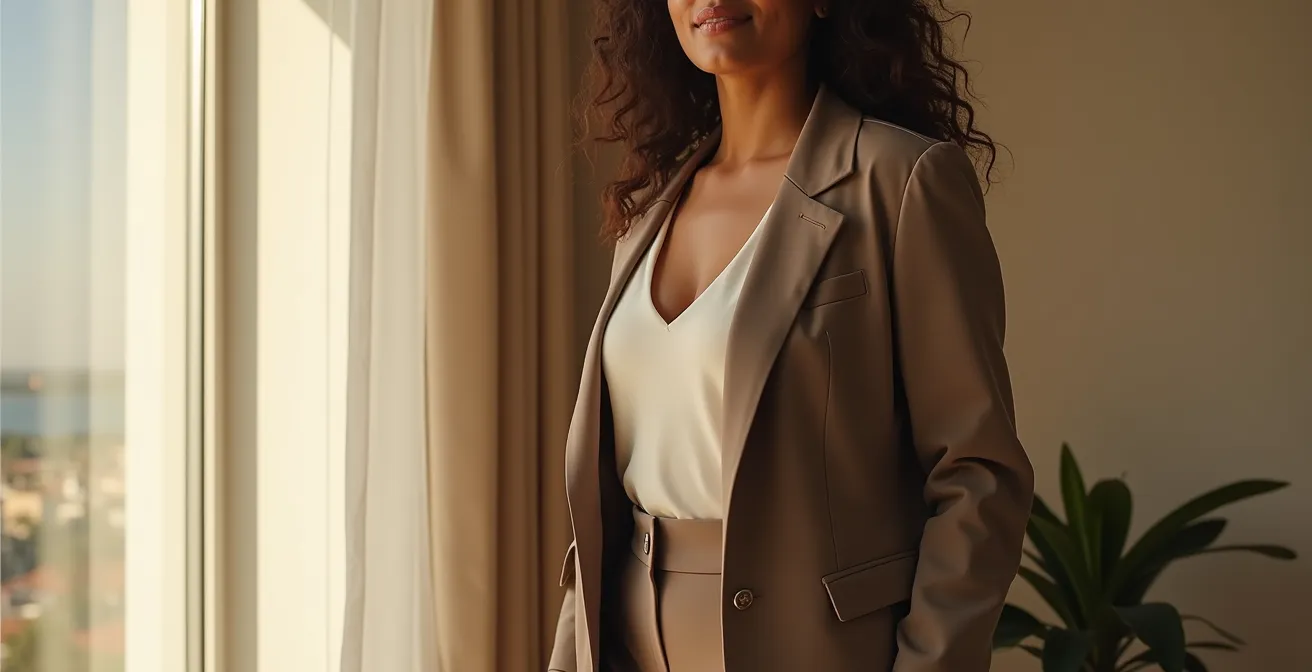
Forget hiding your midsection; the key is to strategically engineer a new silhouette with structure and smart fabrics.
- Fabric integrity is non-negotiable. Structured knits like ponte glide over curves, while thin jersey clings and highlights.
- Rise and waistband construction are your foundational tools for avoiding the “muffin top” effect and providing all-day comfort.
Recommendation: Shift from “defensive dressing” (hiding your body) to “offensive dressing” by using clothes to highlight your best assets and create powerful, confident lines.
If you’re a midsize woman with an apple body shape, you likely live in a frustrating style no-man’s-land. Mainstream advice tells you to “create a waist” with belts that just feel awkward over a fuller midsection, while plus-size fashion can feel too voluminous. You’re told to wear V-necks and A-line skirts, but these generic rules often fall flat, leaving you feeling more boxy, not less. The constant search for clothes that fit both your bust and hips without clinging to your stomach is exhausting.
The advice you’ve been given is often flawed because it’s based on hiding your shape rather than working with it. But what if the secret wasn’t about cinching, belting, or hiding under baggy layers? What if the real solution lies in a form of sartorial engineering? It’s about understanding the physics of fabric, the power of line direction, and the psychology of a confident stance. This isn’t about finding a “magic” dress; it’s about building a toolkit of principles to redefine your silhouette from the ground up.
This guide will deconstruct the common style myths that fail apple shapes and replace them with tactical, actionable strategies. We’ll explore why certain fabrics are your worst enemy, how to choose pants that actually work, and how layering can become your most powerful tool. Prepare to stop hiding and start building.
Summary: The Ultimate Guide to Styling the Midsize Apple Body
- Why Empire Waists Often Make Apple Shapes Look Boxy?
- High-Rise or Mid-Rise: Which Avoids the “Muffin Top” Effect?
- The Jersey Fabric Mistake That Highlights Every Roll
- Which Layer First: Choosing Shapewear That Doesn’t Roll Down
- Problem & Solution: Using Open Jackets to Create Vertical Lines
- Why Stretching Doesn’t Release Tight Muscles Caused by Stress?
- Why Peach Corrector Hides Dark Circles Better Than Heavy Concealer?
- How to Use Silence and Stance to Command a Room Without Speaking?
Why Empire Waists Often Make Apple Shapes Look Boxy?
The empire waist is consistently recommended for apple shapes, yet it’s often the biggest culprit in creating a shapeless, “tent-like” effect. The logic seems sound: place the waistline at the narrowest part of the torso, right under the bust. However, for an apple shape, the torso doesn’t dramatically narrow again below this point. The fabric of a typical empire dress falls straight down from the bust, skimming over the waist and hips, effectively creating a straight, boxy line from your shoulders to your hem.
The problem is one of both fabric and structure. Stiff fabrics like poplin or standard cotton don’t have the weight to drape; they hold their shape, creating that dreaded tent. Instead of hinting at the body underneath, they erase it. The key is not to abandon the high waistline altogether but to be far more strategic about how you create it. Fluid fabrics like viscose or Tencel can provide the same elongating effect while draping more closely to the body, hinting at a shape underneath.
An even better approach is the “Faux Empire” technique. You can achieve the high-waisted illusion by pairing a cropped jacket or a tied-up shirt over high-waisted bottoms. This creates a visual break and a defined line exactly where you want it, but because the pieces are separate, you avoid the single, unbroken curtain of fabric. Look for empire-style tops or dresses that incorporate subtle side ruching or diagonal seams, as these details break up the vertical expanse and create the illusion of curves.
High-Rise or Mid-Rise: Which Avoids the “Muffin Top” Effect?
For an apple shape, the battle with pants is real. The wrong rise can either create a “muffin top” by cutting across the fullest part of your stomach or add bulk where you least want it. The debate between high-rise and mid-rise isn’t about which is universally better, but about which construction works for your specific body and comfort. A high-rise that sits above your fullest part can be brilliant for definition, while a mid-rise with excellent stretch might be better for all-day comfort and movement.
The secret is in the waistband. A thin, simple elastic band is your enemy; it will dig, roll, and bisect your midsection. You need a waistband with structural integrity. A wide, contoured waistband is often the most comfortable option as it follows the body’s natural curves and distributes pressure evenly, rather than concentrating it in one sharp line. When choosing pants, always perform the “sit test” in the dressing room. Sit down, bend over. Does the waistband roll down, cut in, or stay comfortably in place? This simple test is non-negotiable.
Look for fabrics that contain at least 2-5% elastane. This provides crucial flexibility that allows the pants to move with you, reducing the tension that causes rolling and digging. Ultimately, your ideal rise is a personal measurement. Find your natural waist by bending to the side; the crease is your starting point. For many apple shapes, a rise that sits about two inches above this point provides the perfect balance of coverage and definition. The following table breaks down how different waistbands serve different needs.
This comparative analysis, based on insights from style experts, shows that the right waistband is a technical choice, not just a style preference. A structured and contoured waistband can make all the difference.
| Waistband Type | Best For | Key Features | Comfort Rating |
|---|---|---|---|
| Wide Contoured | All-day wear | Follows natural curves, distributes pressure | ★★★★★ |
| High-Rise with Structure | Creating waist definition | Sits above fullest part of stomach | ★★★★☆ |
| Mid-Rise with Stretch (2-5% elastane) | Movement & sitting | Flexibility without rolling | ★★★★☆ |
| Paper-bag Waist | Adding shape to lower half | Pleating below waistband creates curves | ★★★☆☆ |
The Jersey Fabric Mistake That Highlights Every Roll
“Avoid clingy fabrics” is one of the most common—and least helpful—pieces of style advice. The real mistake isn’t the fabric family, but the fabric’s weight and structure. A thin, single-knit jersey is often the biggest offender. It has stretch, but it lacks what we’ll call fabric integrity. It’s lightweight and limp, causing it to catch and cling to every curve, roll, and undergarment line, effectively creating a roadmap of the areas you’d rather not emphasize.
This doesn’t mean you have to give up the comfort of knits. The solution is to upgrade to a more substantial, structured knit. Think of it as a hierarchy. According to fashion expert Angie Cox of YouLookFab, fluid and oversized fits that float away from the waistline are an apple shape’s best friend. She advocates for using them to camouflage the midsection while creating structure elsewhere. This is where heavier, double-knit jerseys like Ponte or scuba knit come in. These fabrics offer the same comfort and stretch as their flimsy cousins but have enough weight and density to glide over the body’s curves rather than clinging to them. They provide a smooth, streamlined silhouette without feeling restrictive.
The visual difference is stark. A dress in thin jersey might show the outline of your shapewear, while the same style in a Ponte knit would create a clean, uninterrupted line. This principle applies to tops, dresses, and even skirts. When shopping, feel the fabric. Does it feel substantial? Does it have a “bounce-back” quality when you stretch it? Or does it feel thin and almost transparent? Choosing fabrics with integrity is the first step in engineering your silhouette.
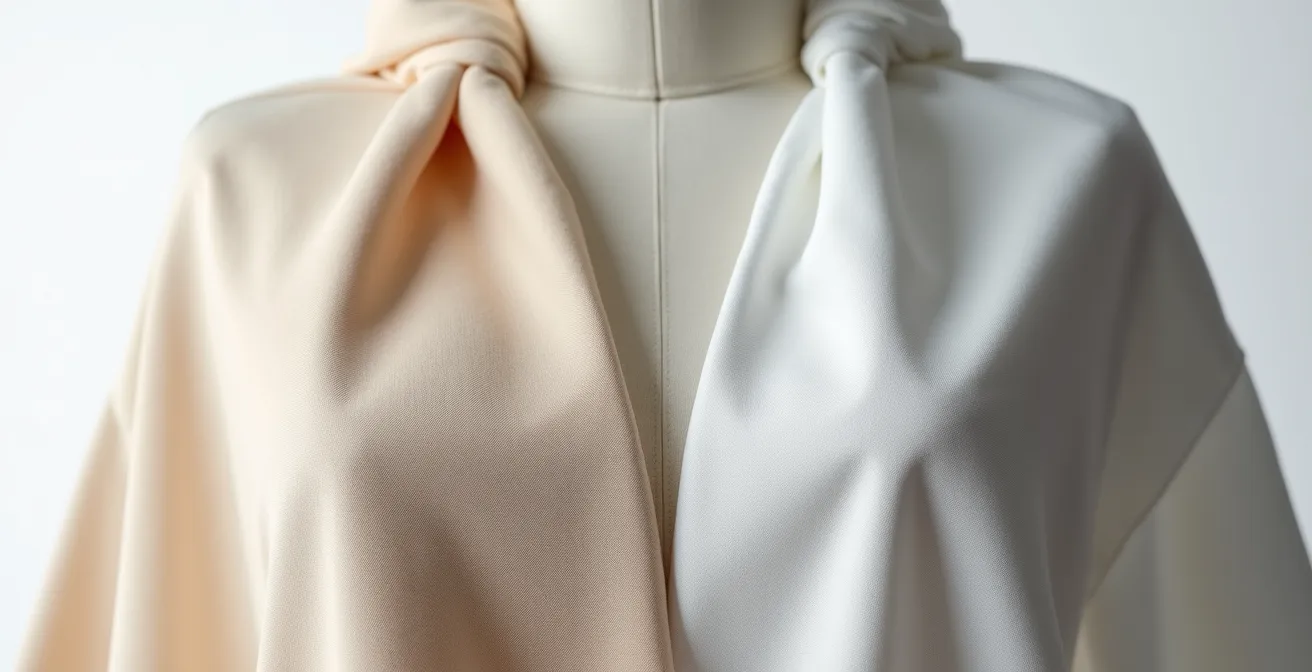
As this comparison shows, the structure of the fabric itself does most of the styling work for you. A fabric with integrity provides a smoothing effect that no amount of styling tricks can replicate with a flimsy material. It’s about choosing materials that work with you, not against you.
Which Layer First: Choosing Shapewear That Doesn’t Roll Down
Shapewear can be a powerful tool, but for many apple shapes, it becomes a source of frustration. The most common complaint is the dreaded roll-down, where the top of a high-waisted shaper or brief curls down over itself, creating an uncomfortable and unsightly bulge. This almost always happens for one of two reasons: the shapewear is the wrong size, or it isn’t properly anchored.
Counterintuitively, shapewear that is too small is the most likely to roll. As one fashion industry analysis points out, a garment that is too tight is under more tension and will actively work to pull away from the body. This is a common mistake women make, thinking tighter equals more shaping.
Shapewear that is too small will actually create more rolls and will be under more tension, making it far more likely to roll down.
– Fashion Industry Analysis, Shapewear Market Report 2024
If you’re between sizes, always size up. The goal is smoothing, not constricting. Proper fit is so critical that recent body shapewear market research shows that 53.4% of shapewear purchases in 2024 were made in-store where fitting assistance is available. The second key is anchoring. A high-waisted style should reach all the way up to your bra line. Tucking the top of the shapewear securely under the band of your bra will prevent it from going anywhere all day. Open-bust bodysuits are another excellent option, as they integrate torso smoothing with your own supportive bra, creating a single, secure unit.
Your Action Plan: The Anti-Roll Shapewear Selection Strategy
- Choose high-waisted shapewear that reaches your bra line and tuck it under the bra band for anchoring.
- If you are between sizes, always size up; too-tight shapewear creates more rolls and is more likely to roll down.
- Consider open-bust bodysuits or shaping camisoles that integrate torso and bust support into one seamless piece.
- Look for customizable options with adjustable features, which allow for a more precise and comfortable fit.
- Always test shapewear by sitting, bending, and moving before committing to ensure it stays securely in place.
Problem & Solution: Using Open Jackets to Create Vertical Lines
Once your foundations are in place, the next step in silhouette engineering is layering. For an apple shape, an open jacket, blazer, or cardigan is one of the most effective tools in your arsenal. When worn open over a column of color underneath, it instantly creates two strong, vertical lines that draw the eye up and down. This trick of the eye visually narrows the torso and de-emphasizes the width of the midsection.
The concept is often called creating a “column of color.” This doesn’t mean you have to wear the exact same color from head to toe. As stylist Gabrielle Arruda demonstrates, wearing similar “value” colors (e.g., all light tones or all dark tones) under a contrasting jacket creates the same elongating effect. The open jacket frames this inner column, essentially slicing off the sides of the torso from a visual perspective and creating a longer, leaner line.
The length and structure of the jacket are also critical. A cropped, tailored jacket that hits just above the hip bone can help to create the illusion of a higher waistline. Conversely, a longline duster or open cardigan that falls to the mid-thigh offers maximum vertical elongation, gracefully skimming over the midsection. A structured blazer that hits at the hip bone is a versatile option that provides balanced proportions, especially when paired with straight-leg pants. Avoid jackets that end at the widest part of your midsection or hips, as this will draw a horizontal line right where you don’t want it.
Experiment with different textures and structures. A crisp blazer adds sharp lines, a soft, flowing kimono adds movement without bulk, and a long vest offers the same vertical lines without adding any heat or arm constriction. This “third piece” is what elevates an outfit from basic to intentional, giving you control over your final silhouette.
Why Stretching Doesn’t Release Tight Muscles Caused by Stress?
You know that feeling of tension in your shoulders and back, the kind that makes you want to constantly stretch and readjust? We often attribute it solely to stress or poor posture. But for many women, a significant part of that physical discomfort comes directly from their clothing. A waistband that digs, a bra that constricts, or a top that you’re constantly pulling down creates a low-grade, persistent physical stress on your body. No amount of stretching can release muscle tension that is being actively caused by a restrictive garment.
The solution isn’t another yoga class; it’s dressing in a way that promotes, rather than fights, good posture. Research on the “posture-fashion connection” shows that certain clothing choices can physically encourage better alignment. Garments with structured shoulders, for instance, naturally encourage you to pull your shoulders back and stand taller. This simple change does more than just improve your posture; it prevents the forward slump that pushes the abdomen out, instantly minimizing the appearance of the midsection.
A well-fitted, supportive bra is another non-negotiable component. The right bra lifts the bust, which in turn elongates the torso and improves posture significantly. When your body isn’t fighting against uncomfortable clothes, it can relax. Choosing fabrics that move with you, like modal or tencel, and waistbands that don’t dig in, reduces the physical stress signals being sent to your brain. This is about creating a feeling of ease in your clothes, which translates to a more relaxed and confident physical presence.

As you can see, the right garment structure doesn’t force you into a new position; it simply makes the correct posture the most comfortable one. When your clothes support you, you stop fighting them, and that’s a form of release that no stretch can replicate.
Why Peach Corrector Hides Dark Circles Better Than Heavy Concealer?
In makeup, anyone with dark, bluish under-eye circles knows a heavy, light-colored concealer often just creates a grey, ashy mess. The real magic comes from a peach or orange color corrector. Why? It’s simple color theory. Peach tones are opposite blue on the color wheel, so they neutralize the darkness, allowing a light layer of concealer on top to look bright and natural. The exact same principle of strategic color correction can be applied to your wardrobe to manipulate where the eye is drawn.
If you feel your midsection commands too much attention, the solution isn’t to cover it in drab, “slimming” black. That’s the equivalent of packing on heavy concealer. The more effective strategy is to create a “correctional” focal point elsewhere. By placing bright colors, bold patterns, or statement accessories near your face, you are applying the principles of color theory to your outfit. A vibrant scarf, a pair of statement earrings, or a brightly colored top naturally draws the eye upward, away from the midsection.
This isn’t about distraction; it’s about direction. You are telling people where to look. Layering necklaces of different lengths can create vertical lines that elongate the torso, while eye-catching shoes can create a secondary focal point at your feet, keeping the gaze moving. This technique allows you to wear comfortable, simple pieces on your torso while your accessories do the heavy lifting of directing attention. It’s an advanced tactic that moves beyond just fit and into the realm of visual psychology.
Think of your outfit in terms of “hot” and “cold” spots. If you want to cool down the attention on your midsection, you need to create a “hot spot” somewhere else. This could be a bold lipstick, a fantastic haircut, a colorful handbag, or a beautifully printed blouse. You’re using color and interest to neutralize the area you want to de-emphasize, just as a peach corrector neutralizes blue.
Key Takeaways
- Embrace Fabric Integrity: Ditch flimsy knits for structured fabrics like ponte that glide over curves instead of clinging to them.
- Engineer Your Silhouette: Use open jackets to create vertical lines and “faux empire” techniques to define your waist without adding bulk.
- Practice “Offensive Dressing”: Stop hiding. Use color, accessories, and great-fitting clothes to highlight your assets and direct the eye where you want it to go.
How to Use Silence and Stance to Command a Room Without Speaking?
Your physical presence—your stance, your posture, how you occupy space—communicates volumes before you ever say a word. True confidence is often silent. It’s in the way you stand, the way you move, and the way you are simply at ease in your own skin. For many women, this quiet confidence is constantly sabotaged by their clothing. It’s impossible to command a room when you’re subconsciously tugging at a hemline, adjusting a waistband, or worrying if your shapewear is rolling down.
This is where the principles of dressing an apple shape transcend aesthetics and become about psychology. When you are wearing clothes that fit perfectly, are physically comfortable, and make you feel powerful, your mind is freed from the distraction of wardrobe anxiety. As one style psychology expert noted:
When you’re not subconsciously tugging at your top or worrying if your pants are digging in, your mental energy is freed. This shifts your body language from self-conscious to open and confident.
– Style Psychology Expert, How Clothing Affects Confidence Study
This mental shift is the foundation of a commanding stance. It represents a move from “defensive dressing” (choosing clothes to hide what you perceive as flaws) to “offensive dressing” (choosing clothes to highlight your assets and express your personality). An apple shape’s assets are often fantastic legs, a great bust, or strong shoulders. Offensive dressing means choosing the amazing printed pants, the V-neck top that showcases your décolletage, or the structured blazer that makes you feel like a CEO. When you lead with your strengths, your entire posture changes from closed and protective to open and authoritative.
Ultimately, the goal of all these tactics—choosing the right fabrics, mastering your rise, layering effectively—is to get to a place where you can put on your clothes and completely forget about them. That freedom is the final ingredient. It allows you to walk into a room and focus not on your body, but on your purpose. That is the source of a powerful, silent stance.
Take these principles and start experimenting. Move from a mindset of hiding to one of highlighting. By engineering your silhouette with intention, you’re not just changing your clothes; you’re changing the way you carry yourself in the world.