
In summary:
- Your home’s resilience depends on a chain of connections, and a single weak link—often the soffits—can trigger a total structural failure.
- Impact-rated products are useless if installed with the wrong fasteners; verification is not optional, it’s essential for survival.
- Protecting your home from flooding and power outages requires systems-level thinking, from advanced water barriers to safe, professional generator connections.
- Forensic-level documentation of your home’s pre-storm condition is the only way to guarantee a fair and complete insurance payout after a disaster.
As a homeowner on the Florida or Gulf Coast, you’re no stranger to hurricane season. You know the routine: track the cone, board up windows, and stock up on supplies. But with storms intensifying, the old playbook may no longer be enough. The anxiety you feel watching a Category 4 storm approach is justified, because conventional wisdom often focuses on surviving the storm, not ensuring your home does. Many homeowners believe impact windows and a generator are the gold standard of preparedness, but this is a dangerously incomplete picture.
The real threat from an intense hurricane isn’t a single catastrophic impact, but a series of small, overlooked vulnerabilities that lead to a cascade failure. A soffit rips off, pressurizing the attic and blowing the roof off from the inside. Incorrect screws on a multi-thousand-dollar impact window fail, turning it into a projectile. These are not freak accidents; they are predictable outcomes of a system where the weakest link dictates the fate of the entire structure. This is the difference between an engineering approach and simple “preparedness”.
This guide moves beyond the basics. We will not rehash tips about trimming trees or building an emergency kit. Instead, we will adopt the mindset of a structural engineer to dissect your home’s most critical failure points. We will examine the hidden weaknesses in your roof, the non-negotiable details of window installation, the lethal mistakes made with generators, and the precise steps to ensure you can rebuild, both structurally and financially. This is about building a continuous load path—a shield of resilience from your foundation to your roof ridge.
This article provides a detailed, system-by-system breakdown to help you identify and rectify the critical vulnerabilities in your coastal home. Explore the sections below to understand the engineering principles that separate a house that survives from one that is destroyed.
Contents: How to Fortify a Coastal Home Against Category 4 Hurricanes
- Why Soffits Are the Weakest Link in Your Roof During a Hurricane?
- How to Verify if Your Contractor Used the Correct Screws for Impact Windows?
- Sandbags or Hydro-Barriers: Which Stops Garage Flooding Better?
- The Connection Mistake That Kills Utility Workers After a Storm
- Problem & Solution: Documenting Pre-Storm Condition to Guarantee Payouts
- How to Reinforce Modular Joints to Survive Daily Reconfiguration?
- How to Size Your Battery to Survive a 3-Day Blackout?
- How to Calculate the Payback Period of a Home Battery System With Current Energy Prices?
Why Soffits Are the Weakest Link in Your Roof During a Hurricane?
In the violent, swirling winds of a hurricane, most homeowners focus on the roof’s surface—the shingles. But the true Achilles’ heel is often hidden underneath the eaves: the soffits. These panels, typically made of vinyl or aluminum, are not merely decorative. During a storm, wind-driven rain and pressure find their way into these vents. If the soffit panels fail and are torn away, it creates a direct entry point for hurricane-force winds into your attic. This is the beginning of a catastrophic cascade failure.
Once the attic is pressurized, the immense force pushes upwards on the roof decking from the inside. This internal pressure, combined with the negative pressure (lift) created by wind flowing over the roof, can be enough to rip the entire roof structure from the walls. It doesn’t matter how well your shingles are attached if the underlying structure is compromised from below. The integrity of your entire home hinges on securing this often-neglected component of the building envelope integrity.
Case Study: The FORTIFIED Difference in Hurricane Sally
The critical role of soffit and roof system integrity was starkly demonstrated during Hurricane Sally in 2020. In neighborhoods where standard-construction homes saw their roofs peeled back and interiors destroyed, homes built to the FORTIFIED standard, like those owned by Ben Murphy, stood largely unscathed. The key difference was the implementation of a sealed roof deck and robust soffit attachment systems, which prevented the initial breach that led to catastrophic failure in neighboring properties. This real-world example proves that focusing on the complete roof system, especially the soffits, is paramount.
Ensuring your soffits can withstand these forces is not a DIY weekend project; it requires adherence to stringent building standards designed for high-wind regions. This includes specific fastening patterns, corrosion-resistant hardware, and proper backing material to prevent the panels from being ripped away.
Your FORTIFIED Roof Soffit Inspection Checklist
- Verify Ventilation: Ensure soffit ventilation meets FORTIFIED standards. This typically involves continuous ridge and soffit vents that are properly sealed to prevent water intrusion while allowing airflow.
- Check Fastening Pattern: Examine the screws or nails used. They must be corrosion-resistant and spaced no more than 12 inches apart at the edges and in the field of the panel.
- Inspect Backing Material: For vinyl soffits, confirm they are installed over a solid backing of at least 7/16-inch OSB or plywood. This backing provides the structural anchor point for the fasteners.
- Confirm Sealed Roof Deck: Check for evidence of a sealed roof deck system, such as a fully adhered membrane or taped sheathing seams under the shingles. This is the secondary line of defense if a soffit is breached.
- Test Soffit Panel Stability: Carefully apply moderate upward pressure to the soffit panels. There should be no significant movement, flexing, or rattling. Any looseness is a sign of improper fastening.
How to Verify if Your Contractor Used the Correct Screws for Impact Windows?
You invested tens of thousands of dollars in high-performance, impact-rated windows. You feel secure, but that security is an illusion if the windows are not anchored to your home’s structure correctly. The window itself is only half the system; the other half is the collection of fasteners holding it in place against unimaginable forces. A contractor taking shortcuts or using the wrong type of screw can render your expensive investment completely worthless. During a storm, the window can be ripped out of the opening, creating a catastrophic breach in your home’s protective shell.
Verification is not an act of distrust; it is a mandatory step in due diligence. Every impact window and door system sold in a high-velocity hurricane zone comes with a Notice of Acceptance (NOA) from a body like Miami-Dade County. This document is the bible for your product. It specifies the exact type, material, length, and spacing of fasteners required for the installation to meet its tested rating. For example, the Florida Building Code specifies a design wind speed of 175 mph in Miami-Dade County for many structures, and the fasteners are engineered to withstand those precise forces.
This close-up view shows the critical details of a correct installation. Notice how the stainless steel screw is anchored deeply into the solid wood buck, not just the superficial stucco or frame.
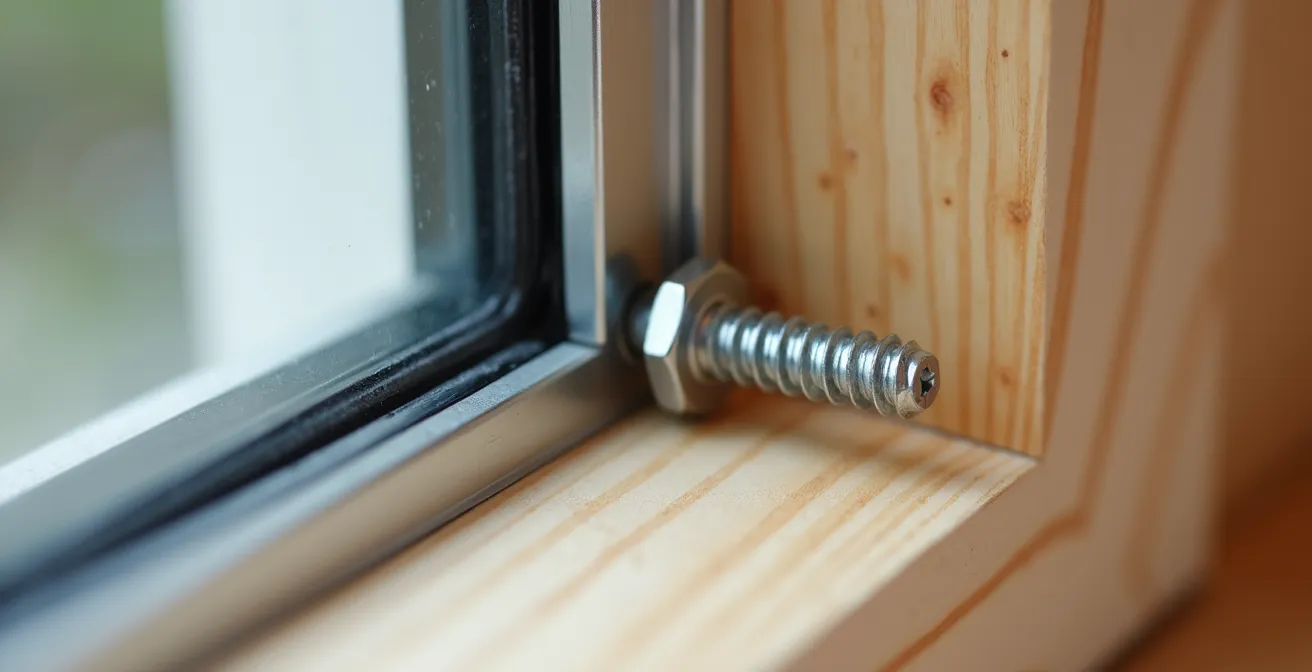
The most common and dangerous installation error is using screws that are too short or made of the wrong material. Standard steel screws will corrode and fail in a coastal environment. Screws must penetrate deep into the structural framing of the house—the wood “buck” or concrete block—not just the window frame. Before your project begins, demand the NOA from your contractor and be present during installation to verify that the fasteners being used match the specifications exactly. Your home’s survival depends on these small but mighty components.
Sandbags or Hydro-Barriers: Which Stops Garage Flooding Better?
While wind gets the headlines, storm surge and flooding cause devastating structural damage. The garage door is often the largest and weakest entry point for floodwaters. A breached garage door can lead to feet of water inside your home, destroying property and potentially compromising the foundation. For decades, the go-to solution has been sandbags. However, they are labor-intensive, shockingly ineffective when not stacked perfectly, and create a contaminated waste problem after the storm. Modern engineering offers far superior alternatives.
Hydro-barriers, which include products like water-activated bags (sandless sandbags) and larger, fillable systems like TrapBags, represent a significant leap in flood defense technology. They are designed to create a continuous, more impermeable seal than a wall of porous, lumpy sandbags. They are also significantly faster to deploy, a critical advantage when a storm is hours away. While the upfront cost may be higher, their reusability and superior performance make them a wise investment in protecting your most valuable asset.
The following comparison breaks down the practical differences between these two approaches. As this comparative analysis of flood barriers shows, modern solutions offer significant advantages in deployment speed and effectiveness.
| Criteria | Traditional Sandbags | Hydro-Barriers/TrapBags |
|---|---|---|
| Setup Time (100ft barrier) | 6-8 hours with 4 people | 2-3 hours with 2 people |
| Cost per Linear Foot | $15-25 (including sand/labor) | $35-45 initial, reusable |
| Effectiveness Against 2ft Storm Surge | 60-70% (gaps between bags) | 90-95% (continuous barrier) |
| Fill Material Required | 8,000 sandbags for 100ft x 4ft | 40% less fill than sandbags |
| Reusability | Single use, contamination risk | Multiple deployments possible |
The choice is clear. For a homeowner serious about preventing garage flooding, investing in a modern hydro-barrier system is the most effective and efficient strategy. For rapid deployment, water-activated products like Quick Dam can be a lifesaver, expanding in minutes to create a barrier without the need for any fill material. For larger or more predictable threats, fillable systems provide a more robust and taller wall of protection. Relying on sandbags is a gamble against the physics of water.
The Connection Mistake That Kills Utility Workers After a Storm
After a hurricane, a portable generator can feel like a lifeline, restoring a sense of normalcy amidst the chaos. But if connected improperly, that lifeline can become a lethal weapon. The most dangerous mistake a homeowner can make is “backfeeding”—connecting a generator directly into a wall outlet or the home’s main electrical panel. This act sends powerful electrical current back through the utility lines, a path it was never meant to travel.
This backfed electricity energizes the very power lines that utility workers believe are dead. A lineman working to restore power to your neighborhood can be electrocuted without warning. This is not a hypothetical risk; it is a tragic and preventable reality after every major storm. With widespread outages becoming more common, as when Hurricane Beryl knocked out power to over 2.5 million people, the number of generators in use skyrockets, and so does the danger.
The only safe way to power your home with a generator is through a professionally installed transfer switch. This device isolates your home’s electrical system from the grid before it allows the generator to supply power. It creates a physical “break-before-make” barrier, making it impossible for your generator’s electricity to travel back to the utility lines.
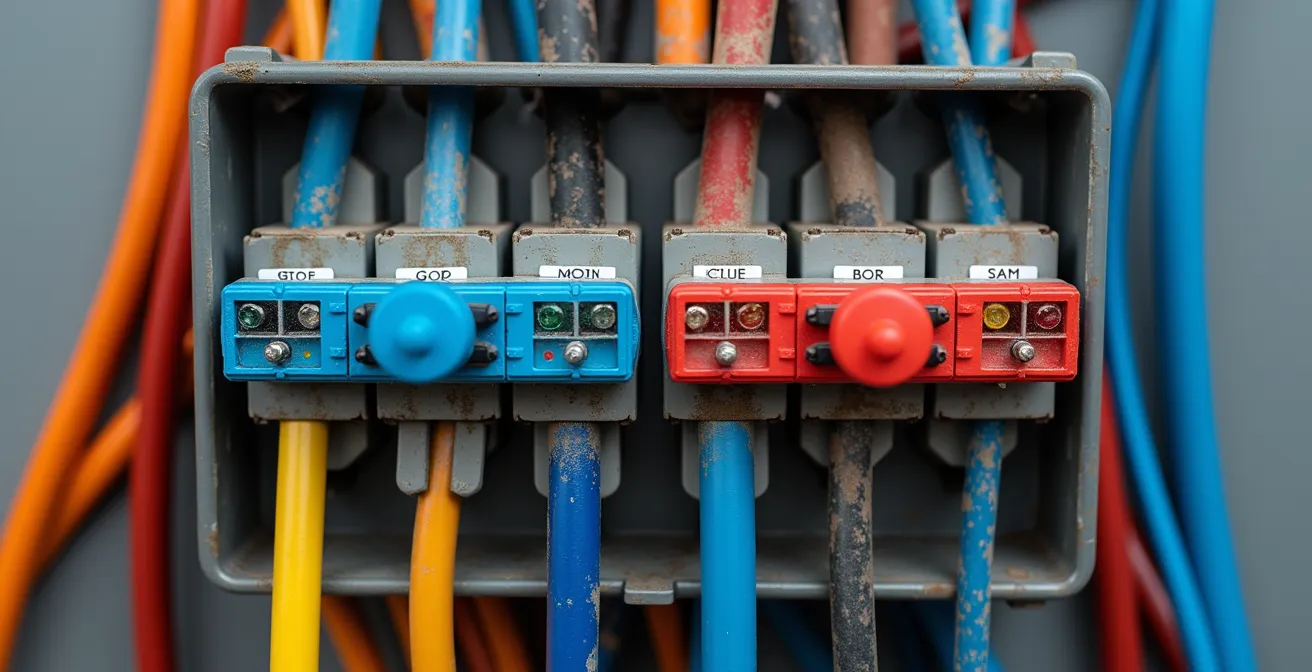
As the image illustrates, a transfer switch acts as a traffic cop for electricity, ensuring that power from the grid and power from your generator can never occupy the same path. Installing a transfer switch is not a recommendation; it is an absolute duty for any homeowner who plans to use a generator. It protects your appliances from damage, your home from electrical fires, and most importantly, it protects the lives of the people working to put your community back together.
Problem & Solution: Documenting Pre-Storm Condition to Guarantee Payouts
The problem is simple: after a devastating storm, your insurance company’s goal is to minimize their payout. You, the homeowner, are in a state of shock, your home is in ruins, and you lack the evidence to prove the full extent of your loss. The solution is to think like a forensic investigator *before* the storm hits. A few blurry photos of your living room are not enough. You need to create an irrefutable, time-stamped record of your home’s condition and contents.
This process of forensic documentation is your most powerful tool in an insurance negotiation. It shifts the burden of proof. Instead of you trying to prove what you lost, the insurance company has to dispute your meticulously documented evidence. This includes not just wide shots of rooms, but detailed videos of appliance serial numbers, close-ups of structural elements in the attic and crawlspace, and a written inventory with purchase dates and values. This level of detail is what separates a frustrating, low-ball settlement from a payout that allows you to fully rebuild your life.
This documentation can also capture the success of your mitigation efforts, proving that certain systems performed as designed. For example, the detailed documentation from the Reimold family after Hurricane Helene showed that their elevated electrical outlets prevented fires and that their flood vents correctly limited water intrusion to 2.5 feet, which is critical data for validating building techniques and securing claims. Your goal is to leave no room for ambiguity. Every valuable item, every structural component, and every upgrade should be recorded from multiple angles.
The final, crucial step is backing up this data. A hard drive left in the house is useless if the house is destroyed. Your documentation must be uploaded to at least two separate cloud services, and a physical copy on a waterproof USB drive should be stored off-site in a safe deposit box or with out-of-state family. This redundancy ensures your proof survives even if your home does not.
How to Reinforce Modular Joints to Survive Daily Reconfiguration?
Modular homes offer many advantages in terms of construction speed and quality control. However, their very nature—being constructed in sections and joined on-site—creates inherent structural challenges in a hurricane zone. The “marriage lines” where modules connect are potential weak points. While these homes are built to code, a Category 4 hurricane subjects them to forces that can test those connections to their absolute limit. The term “daily reconfiguration” can be seen as a metaphor for the violent, multi-directional forces of a hurricane that attempt to tear the modules apart.
To fortify a modular home for extreme weather, you must go beyond standard construction and reinforce these joints to create a truly monolithic structure. This involves creating a continuous load path that ties the entire home together, from the roof trusses down to the foundation. This is not about simply sealing the seams against water; it’s about adding structural steel and mechanical fasteners that transfer the immense wind loads safely through the building and into the ground.
Key reinforcement strategies include installing continuous steel strapping that runs vertically across the marriage lines, connecting the roof system directly to the floor system and foundation. Inside the attic and crawlspace, additional hurricane clips and tension ties must be added at every truss-to-wall and floor-to-wall connection, especially at the module seams. Furthermore, reinforcing the marriage line itself with high-strength structural adhesive and additional lag bolts provides another layer of defense against shear and uplift forces. This comprehensive approach transforms a collection of strong boxes into a single, unified fortress capable of withstanding the storm’s attempts to reconfigure it.
How to Size Your Battery to Survive a 3-Day Blackout?
A multi-day power outage after a hurricane is not an inconvenience; it’s a crisis. It means no refrigeration, no medical devices, no communication, and no sump pump to fight residual flooding. A home battery backup system provides energy independence, but its effectiveness depends entirely on proper sizing. An undersized battery will leave you in the dark on day two. Sizing a battery is a methodical process of calculating your “critical load”—the absolute essential devices you need to survive for a minimum of 72 hours.
First, you must list every essential appliance and its power consumption. This includes the continuous running watts and, crucially, the “surge” watts required to start motors in devices like refrigerators or pumps. A typical critical load includes the refrigerator, a sump pump, essential medical equipment, a few lights, and your internet modem/router. You must calculate the total kilowatt-hours (kWh) needed per day and multiply by three. Then, add a safety buffer of at least 25% for unexpected needs and another 15% to account for energy loss during power inversion (DC to AC). This calculation determines the minimum usable capacity your battery system must have.
The chemistry of the battery is also a critical safety consideration. For hurricane-prone areas, Lithium Iron Phosphate (LFP) batteries are the superior choice over Nickel Manganese Cobalt (NMC) chemistries, even though NMC is more common in electric vehicles.
| Feature | LFP (Lithium Iron Phosphate) | NMC (Nickel Manganese Cobalt) |
|---|---|---|
| Cycle Life | 6,000+ cycles at 80% DoD | 3,000-4,000 cycles at 80% DoD |
| Safety in Flooding | Minimal thermal runaway risk | Higher fire risk if damaged |
| Power Density | 90-120 Wh/kg | 150-220 Wh/kg |
| Best For Hurricane Use | Yes – safer in extreme conditions | No – higher risk profile |
LFP batteries are far more thermally stable and resistant to fire if damaged, a significant safety advantage in a chaotic post-storm environment where flooding could occur. While they are slightly less energy-dense, their superior safety profile and longer cycle life make them the responsible engineering choice for home resilience.
Key Takeaways
- The failure of overlooked soffits is a primary trigger for catastrophic roof loss during a hurricane by allowing attic pressurization.
- The performance of expensive impact-rated windows is entirely dependent on the use of correct, code-specified fasteners anchored into the building’s structure.
- For electrical safety and the protection of utility workers, a professionally installed transfer switch is the only acceptable method for connecting a generator to a home.
How to Calculate the Payback Period of a Home Battery System With Current Energy Prices?
Investing in a home battery system is a significant financial decision. While the primary driver is resilience and safety during a blackout, the economic case for these systems is becoming increasingly compelling. Calculating the payback period is not just about avoiding outage costs; it’s a comprehensive analysis of energy savings, potential income, and government incentives. A complete Return on Investment (ROI) calculation reveals that a battery can be more than just an insurance policy—it can be an active asset.
The first component of your savings comes from “Time-of-Use (TOU) arbitrage.” If your utility charges higher rates during peak demand hours (e.g., late afternoon), you can charge your battery with cheap off-peak power overnight and use that stored energy during the expensive peak hours, directly reducing your monthly bill. Second, many utilities offer “Demand Response” programs that pay you for allowing them to draw power from your battery during grid emergencies, creating a direct income stream. Third, significant government incentives, like the 30% Federal Tax Credit available through 2032, can dramatically reduce the net cost of the system.
Finally, and most relevant to hurricane preparedness, you must quantify the “avoided losses” from a multi-day outage. This includes the cost of spoiled food, potential hotel stays, and lost income if you work from home. When you sum the annual TOU savings, demand response income, and the value of avoided outage losses, and compare that to the post-incentive cost of the system, you get a clear picture of your payback period. For many homeowners in high-cost energy markets, this period can be surprisingly short, making the decision to invest in energy independence both a practical and a financially sound one.
Fortifying your home is a systematic process. The first step is a thorough audit of your property’s current state. Use the checklists and principles in this guide to conduct a top-to-bottom inspection, or engage a licensed structural engineer specializing in wind mitigation for a professional assessment. Taking action today is the only way to face the next storm with confidence instead of anxiety.