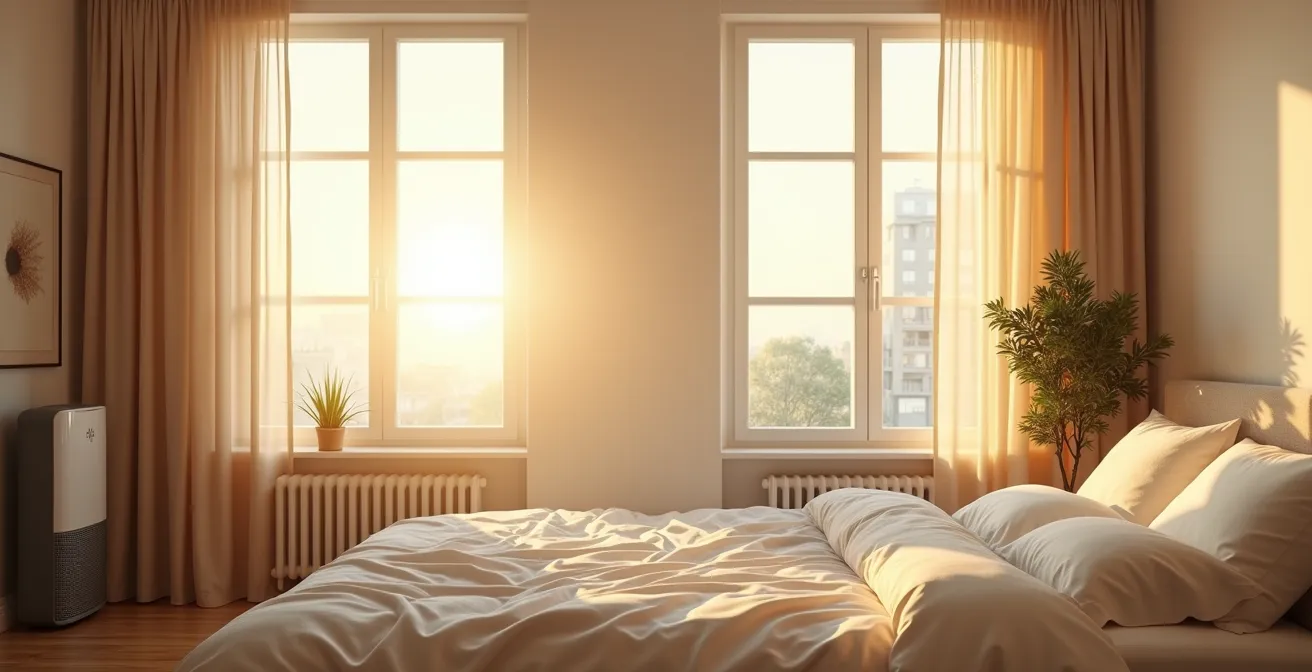
Contrary to popular belief, simply adding a plant or an air freshener does little to combat the complex pollutants in a poorly ventilated bedroom.
- Chemicals from paint and furniture (VOCs), hidden mold spores, and even high CO2 levels from your own breath actively degrade your sleep and health.
- Effective air quality improvement requires a systematic approach: identifying specific threats and implementing targeted environmental controls.
Recommendation: Shift your focus from basic cleaning to active micro-climate management, starting with controlling humidity and ensuring proper airflow behind furniture.
For the health-conscious individual living in an older city apartment, the pursuit of a healthy home environment often hits a wall—literally. Poor ventilation in a bedroom isn’t just a matter of feeling “stuffy”; it’s a chronic issue that can silently undermine your health and sleep quality. You’ve likely tried the common fixes: dutifully dusting, avoiding harsh chemicals, and perhaps placing a hopeful-looking plant in the corner. Yet, a lingering sense of unclean air, morning congestion, or disrupted sleep persists.
The problem is that conventional wisdom often misses the point. The real battle for clean bedroom air isn’t against visible dust, but against a host of invisible threats. These include volatile organic compounds (VOCs) off-gassing from new paint, microscopic mold spores thriving in damp, stagnant air pockets, and even the buildup of carbon dioxide from our own breathing. These pollutants require more than a simple filter or a fragrant candle; they demand a more scientific and systematic approach to environmental control.
But what if the key wasn’t just to “purify” the air, but to fundamentally re-engineer your bedroom’s micro-environment? This guide moves beyond the platitudes to offer a new perspective. We will explore the specific mechanisms behind poor indoor air quality and provide targeted, science-backed protocols to neutralize each threat. It’s time to stop guessing and start implementing precise controls that transform your bedroom into a true sanctuary for health and restorative sleep.
This article will guide you through a systematic process, from identifying chemical pollutants and managing humidity to optimizing your space for both clean air and better sleep. Let’s delve into the specific strategies that make a tangible difference.
Summary: A Comprehensive Guide to Bedroom Air Quality in Poorly Ventilated Spaces
- Why Fresh Paint Smells Can Disrupt Your Deep Sleep Cycle?
- How to Keep Air-Purifying Plants Alive in Low-Light Corners?
- HEPA or Ionizer: Which Is Safer for Asthma Sufferers?
- The Humidity Mistake That Encourages Black Mold Behind Wardrobes
- Problem & Solution: Ventilating a Home During High Pollen Season
- The Egg Carton Myth: Why This Common Hack Fails to Block Sound
- Why Acne Shifts to the Chin and Jawline After Age 25?
- How to Start Somatic Exercises to Relieve Chronic Back Tension?
Why Fresh Paint Smells Can Disrupt Your Deep Sleep Cycle?
That “new paint smell” is more than just an odor; it’s the signature of Volatile Organic Compounds (VOCs) being released into your air. These chemicals, common in paints, finishes, and new furniture, can cause headaches, dizziness, and respiratory irritation. More insidiously, they disrupt your sleep architecture by acting as low-level neurological irritants. Even after the smell fades, off-gassing can continue for weeks, impacting your ability to reach deep, restorative sleep stages. The concentration of these pollutants is often significantly higher indoors. In fact, EPA research found that VOC levels are typically 2 to 5 times higher indoors than outdoors, a problem magnified in a poorly ventilated bedroom.
Simply airing out the room for a day is insufficient. To truly decontaminate the space, you need a systematic protocol. This involves an initial period of “baking” the room—raising the temperature to accelerate VOC release—followed by intense ventilation. This forces the bulk of the chemicals out of the materials and then out of your home. After this purge, an air purifier becomes your long-term management tool, capturing residual compounds. Monitoring with a dedicated VOC detector provides the ultimate assurance, telling you precisely when the air is safe for sleep. This methodical approach is the only way to ensure your freshly decorated sanctuary doesn’t become a source of chronic sleep disruption.
How to Keep Air-Purifying Plants Alive in Low-Light Corners?
Introducing houseplants is a common first step towards better air quality, but it often ends in failure. The platitude “get an air-purifying plant” ignores a critical biological reality: most plants need significant light to photosynthesize and perform their air-cleaning functions. In the low-light corners of a city apartment bedroom, plants like the Peace Lily or Spider Plant will slowly starve, their purification benefits diminishing to near zero. The key is not to give up on plants, but to adopt a bio-integration strategy: treating them as a functional system that requires the right inputs. This means selecting the right species for low-light conditions and supplementing their environment.
This is where creating a “bio-filter station” becomes a game-changer. By pairing a genuinely low-light tolerant plant, such as a Snake Plant, with a dedicated full-spectrum LED grow light, you provide the energy it needs to thrive and actively filter the air. This small intervention transforms a decorative item into a functional, living air purifier.

As the visual demonstrates, even a small, targeted light source can create a pocket of vitality in a dark corner. You must match the plant to its minimal light requirements and provide that light consistently with a timer. The following table provides a clear guide for setting up your own effective bio-filter.
| Plant Type | Minimum Light (foot-candles) | LED Timer Needed (hours/day) | Air Purification Rate |
|---|---|---|---|
| Snake Plant | 50-100 | 4-6 | High |
| Peace Lily | 100-150 | 6-8 | Very High |
| Spider Plant | 150-200 | 6-8 | Moderate |
| English Ivy | 200-250 | 8-10 | High |
HEPA or Ionizer: Which Is Safer for Asthma Sufferers?
When selecting an air purifier, especially for a bedroom and for someone with respiratory sensitivities like asthma, the technology inside matters immensely. The market is dominated by two main types: HEPA filters and ionizers. While both claim to clean the air, their methods and byproducts are critically different. A HEPA (High-Efficiency Particulate Air) filter is a mechanical system. It uses a physical, ultra-fine mesh to trap particles like dust, pollen, pet dander, and mold spores. It removes pollutants from the air without adding anything back in.
An ionizer, on the other hand, works by releasing negatively charged ions into the air. These ions attach to airborne particles, causing them to clump together and fall out of the air or stick to surfaces. The critical flaw in this process is that it can produce ozone as a byproduct. Ozone is a powerful lung irritant that can trigger asthma attacks and worsen respiratory conditions. While many manufacturers claim their devices are safe, EPA measurements show that even ‘safe’ ionizers can produce up to 0.05 ppm of ozone, a level that is not ‘zero’. For an asthmatic, any level of an added irritant poses an unacceptable risk.
This stance is confirmed by air quality authorities. As the California Air Resources Board states in their guidelines, the risk is simply not worth it for sensitive individuals:
For an asthmatic’s hypersensitive lungs, there is no ‘safe’ level of an irritant. Even trace amounts of ozone from ionizers can trigger bronchospasm and inflammation.
– California Air Resources Board, CARB Indoor Air Quality Guidelines 2024
The verdict is clear: for a health-conscious individual, particularly one with asthma, a purifier with a true HEPA filter is the only safe and effective choice for the bedroom. It guarantees removal of particulate matter without introducing harmful chemical irritants like ozone into your breathing space.
The Humidity Mistake That Encourages Black Mold Behind Wardrobes
One of the most common yet overlooked sources of poor bedroom air quality is mold, and it often grows in the places you can’t see. A frequent mistake in poorly ventilated rooms is pushing furniture, like wardrobes and headboards, flush against exterior walls. This creates a “dead air zone” where moisture from breathing and daily activities gets trapped. The wall surface becomes colder than the room’s air, causing condensation—the perfect breeding ground for black mold (Stachybotrys chartarum). Even if you can’t see or smell it, the mold releases spores into the air, which can trigger allergies, asthma, and other respiratory issues.
The solution lies in micro-climate management. Your goal is to prevent these stagnant, damp pockets from ever forming. This starts with maintaining the right overall humidity. Research from the Technical University of Denmark confirms that maintaining bedroom humidity between 40-50% is optimal for preventing mold growth while remaining comfortable for sleep. A simple digital hygrometer can help you monitor this.

The second, equally crucial step is to ensure proper air circulation behind large furniture. As the illustration shows, simply leaving a 2-to-4-inch gap between your wardrobe and the wall allows air to flow freely, preventing moisture from condensing and stagnating. This small adjustment is one of the most powerful and cost-effective ways to prevent a hidden mold problem from compromising the air you breathe every night.
Problem & Solution: Ventilating a Home During High Pollen Season
For allergy sufferers, the advice to “open a window” for fresh air presents a difficult trade-off during high pollen season. Doing so can flood the bedroom with the very allergens you’re trying to avoid, leading to sleepless nights and respiratory distress. Sealing the room completely, however, leads to a buildup of CO2 and other indoor pollutants. The solution is not to choose one or the other, but to adopt a strategic ventilation approach that cleans the air as it enters.
There are several effective strategies, ranging in cost and effort. A “strategic purge,” where you open windows for 5-10 minutes during low-pollen hours (typically late at night or after rain), can exchange most of the stale indoor air without a major influx of allergens. A more advanced method is to create positive pressure by using a fan to push air into the room through a high-MERV filter attached to a window or opening. The most direct approach involves running a HEPA purifier with the windows sealed, which is highly effective but doesn’t address CO2 buildup.
Case Study: The Effectiveness of DIY Window Screen Filters
A highly effective and affordable middle-ground is the use of DIY window filters. The Regional Air Quality Council tested this method by fitting window screens with MERV-13 filter material—the same type used in high-quality HVAC systems. The results were compelling: the filters blocked 85-90% of pollen particles while still allowing for significant airflow. In a practical test, residents using these filters were able to keep their windows open on moderate pollen days to maintain ventilation, without triggering their usual allergic reactions.
The following table compares these strategies, helping you choose the best one for your situation and budget. Each offers a way to break the stalemate between fresh air and allergen exposure.
| Strategy | Effectiveness | Cost | Implementation Time |
|---|---|---|---|
| Strategic Purge (5-10 min at night) | 75% air exchange | Free | Immediate |
| Positive Pressure with Filtered Fan | 90% pollen reduction | $50-100 | 1 hour setup |
| DIY Window Screen Filters (MERV-13) | 85% particle blocking | $20-40 per window | 30 min per window |
| HEPA Purifier + Sealed Windows | 95% indoor pollen reduction | $200-500 | Immediate |
The Egg Carton Myth: Why This Common Hack Fails to Block Sound
In the quest for a quiet bedroom, many people turn to DIY “solutions” seen online, with the most famous being the use of egg cartons on walls. This is a persistent myth based on a misunderstanding of acoustics. Egg cartons are made of thin, lightweight paper pulp. Their shape might slightly scatter or diffuse high-frequency sound waves (a process called diffusion), but they have virtually zero mass or density to actually block or absorb sound energy. Sound waves, especially low-frequency noises like traffic or bass from a neighbor’s stereo, will pass right through them. True soundproofing requires mass (like drywall) and absorption (like dense acoustic foam or mineral wool).
Instead of wasting time on ineffective hacks, a more pragmatic approach to improving sleep in a noisy environment is to focus on what you can control: the soundscape within your room. This is where an air purifier can serve a dual purpose. Many high-quality HEPA purifiers produce a consistent, pleasant “white noise” from their fan. This steady hum is incredibly effective at masking sudden, irregular noises that disrupt sleep. The brain can easily tune out a constant sound, but it’s jolted awake by sharp changes like a car horn or a door slamming. By creating a stable acoustic baseline, the purifier makes these external noises far less jarring.
Your Action Plan: Dual-Benefit Sound Masking Setup
- Choose a HEPA purifier known for its consistent fan sound, aiming for a 45-50 dB output on its medium setting.
- Position the unit 6 to 8 feet from your bed. This allows the sound to distribute evenly throughout the space without creating a directional “source.”
- Set the fan speed to a medium, steady level. Avoid “auto” modes that cause the fan to ramp up and down, as this defeats the purpose of a consistent sound.
- Angle the unit’s airflow away from your bed to prevent a direct draft, which can be uncomfortable and disrupt sleep.
- Use this consistent hum to mask irregular external noises, effectively creating a “cocoon” of stable sound that promotes uninterrupted rest.
Why Acne Shifts to the Chin and Jawline After Age 25?
While teenage acne is often spread across the forehead and cheeks, adult acne, particularly in women over 25, tends to concentrate along the chin and jawline. This shift is often attributed solely to hormonal fluctuations. However, an often-ignored environmental factor can significantly contribute to these specific breakouts: your pillowcase, and the air in your bedroom. In a poorly ventilated room, airborne particulates—dust, pollen, pet dander, and microscopic pollutants—are in constant circulation. Overnight, these particles settle on surfaces, including your pillow.
As you sleep, your face is pressed against this contaminated surface for hours. The combination of friction, moisture from your breath, and a concentrated layer of microscopic irritants can clog pores and trigger an inflammatory response. This is especially true for the jawline and chin, areas that often have direct and sustained contact with the pillow. While hormonal changes create the underlying predisposition for acne, this environmental contamination can be the trigger that causes a visible breakout. You may have a perfect skincare routine, but if you’re laying your face on a contaminated surface every night, you’re fighting a losing battle.
Case Study: The Pillowcase Contamination Link
This connection is more than just theory. In a monitoring study, Atmotube found that pillowcases in poorly ventilated bedrooms accumulated 40% more particulate matter and dust mites compared to those in well-ventilated rooms. The study then implemented a two-part solution for participants: weekly washing of all bedding in hot water and running a HEPA air filter in the bedroom at night. The results were significant: participants saw a 35% reduction in jawline acne incidents over a three-month period, demonstrating a direct link between cleaner air, cleaner surfaces, and clearer skin.
This highlights a crucial aspect of holistic health: your external environment directly impacts your body’s systems, including your skin. Improving your bedroom’s air quality is not just about respiration; it’s also a fundamental step in your skincare regimen.
Key Takeaways
- Poor bedroom air quality is caused by specific, often invisible threats like VOCs, mold, and high CO2, not just dust.
- Effective solutions are targeted: accelerated ventilation for VOCs, micro-climate management for mold, and using the right purifier (HEPA) for particulates.
- Your bedroom’s environment has a holistic impact, affecting not only your sleep and breathing but also your skin health and even physical tension.
How to Start Somatic Exercises to Relieve Chronic Back Tension?
Chronic back tension, especially upon waking, is often blamed on a bad mattress or sleeping position. While these are factors, the quality of the air you breathe can be a surprising and significant contributor. In a poorly ventilated bedroom, carbon dioxide (CO2) from your own exhalations can build up overnight to surprisingly high levels. High CO2 levels are a physiological stressor. Groundbreaking DTU research found that when bedroom CO2 levels exceed 2,600 ppm, it can increase muscle tension by 23%. This happens because your body’s respiratory drive is triggered, leading to shallower breathing and a low-level “fight-or-flight” response, causing muscles, particularly those in the back and shoulders, to clench subconsciously throughout the night.
You wake up feeling stiff and unrested not just because you slept “wrong,” but because your body was in a state of low-grade stress for hours. Somatic exercises are an excellent tool to combat this, as they focus on the internal sensation of the body (interoception) and reconnecting the mind to the muscles to release habitual tension. Starting a simple pre-sleep routine can help “reset” your nervous system before you even get into bed. This isn’t about a strenuous workout; it’s about gentle, mindful movement.
A simple routine can involve a minute of deep breathing by an open window to flush your system with fresh air, followed by gentle neck rolls and cat-cow stretches to release the spine. The final step is a progressive muscle relaxation exercise, consciously tensing and then releasing muscle groups from your toes to your head. This process helps discharge the tension accumulated during the day and counteracts the clenching caused by poor air quality, preparing your body for true, deep relaxation. It addresses the symptom (tension) while you work on the root cause (air quality).
By shifting from passive frustration to active environmental control, you can systematically transform your bedroom from a source of hidden stressors into a true sanctuary for recovery. Begin tonight by implementing one of these strategies to take the first step toward cleaner air and deeper, more restorative sleep.