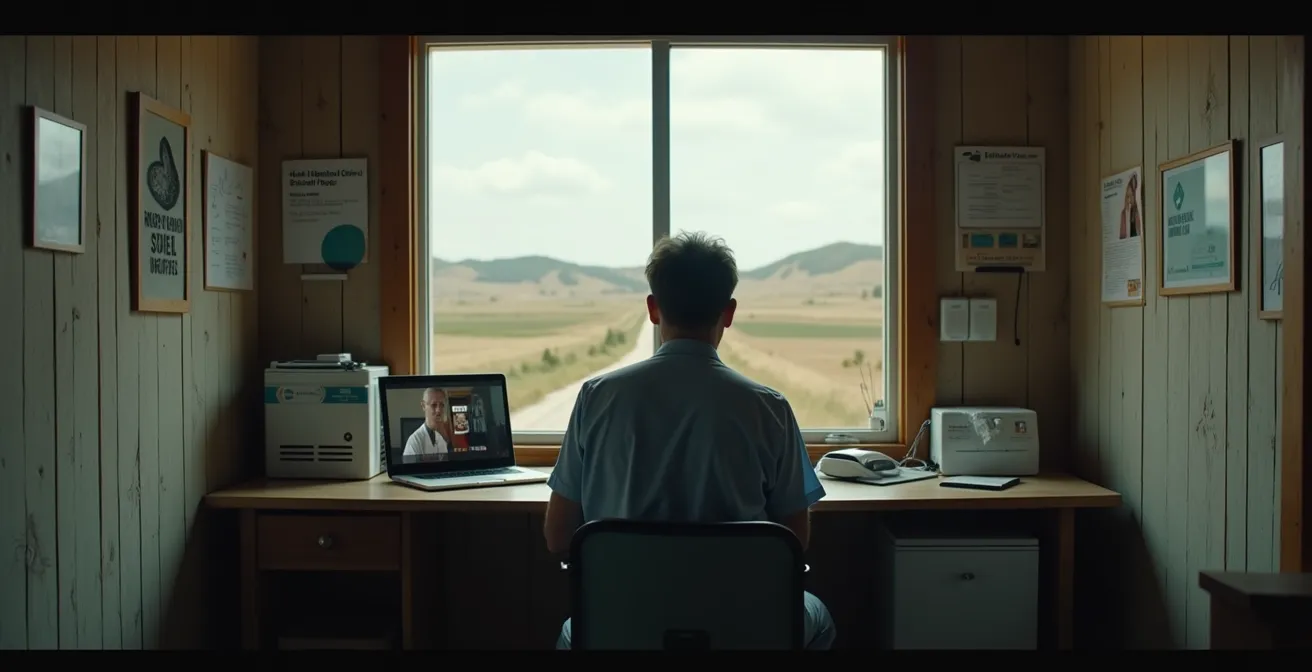
The key to successful rural telehealth isn’t finding a magic high-speed internet solution, but building an operational system that thrives on resource scarcity.
- Choose technology that prioritizes resilience over features, such as platforms with ultra-low bandwidth requirements and automatic audio-only fallback.
- Establish rigid triage and documentation protocols to ensure clinical quality and guarantee insurance reimbursement, even for non-video consultations.
Recommendation: Shift from a purely medical or IT-focused approach to a systems-thinking model, solving connectivity challenges by borrowing proven, low-tech efficiency principles from other industries.
For a clinic administrator in a remote area, the promise of telehealth—improved patient access, efficient follow-ups, continuity of care—often clashes with the harsh reality of poor internet connectivity. The standard advice to simply “get a better internet plan” or “use asynchronous methods” feels inadequate, failing to address the complex web of patient resistance, technology trade-offs, and billing challenges. This approach frames the problem as a simple technical deficit, when it is fundamentally an operational one.
The conventional wisdom focuses on overcoming the lack of bandwidth. But what if the true solution lies in embracing it? The most resilient telehealth programs are not those that depend on perfect, high-speed connections, but those designed to function effectively within the constraints of what is available. This requires a shift in mindset, from seeking a single technological fix to adopting a holistic, systems-thinking approach to healthcare delivery.
This guide reframes the challenge. Instead of just listing telehealth platforms, we will dissect the operational, clinical, and financial systems required for success in a low-bandwidth environment. We will explore why patients hesitate, how to choose genuinely resilient technology, and how to create protocols that ensure both quality of care and financial viability. Crucially, we will look outside of healthcare for unexpected lessons in efficiency and stakeholder management to build a truly sustainable telehealth service.
To navigate these interconnected challenges, this article breaks down the process into a series of actionable steps, from understanding patient psychology to mastering billing codes and even learning from other industries. The following sections provide a complete roadmap for building a resilient telehealth program.
Summary: A Roadmap for Resilient Rural Telehealth
- Why Elderly Patients Refuse Video Calls Even for Simple Checkups?
- Zoom for Healthcare or Doxy.me: Which Is More Secure for Small Practices?
- The Lighting Mistake That Hides Symptoms During Video Consults
- When to Switch From Virtual to In-Person: A Triage Protocol
- How to Code Telehealth Visits to Avoid Insurance Denials?
- Why You Don’t Need Full Wi-Fi Coverage for LoRaWAN Farm Sensors?
- How to Bill Electricity Usage to Specific Parking Spots Without Smart Meters?
- How to Convince a Condo Board to Approve EV Charging Infrastructure?
Why Elderly Patients Refuse Video Calls Even for Simple Checkups?
The initial barrier to telehealth adoption is often human, not technical. For elderly patients, resistance to video calls stems less from a dislike of technology and more from deep-seated anxieties about perception and control. They worry about not being seen or heard correctly, fear that a poor connection will hide a crucial symptom, or feel a loss of the personal connection established through in-person visits. This isn’t just technophobia; it’s a valid concern about the quality and thoroughness of their care. Addressing this requires empathy and proactive communication, not just technical tutorials.
The data underscores this challenge; research on telehealth barriers reveals that an astonishing 82% of homebound elderly patients required caregiver assistance to complete video visits. This dependency creates logistical hurdles and amplifies feelings of vulnerability. Instead of pushing for immediate adoption, a successful strategy involves building trust gradually. This can include offering an audio-only option for the first consultation to establish comfort, or scheduling short, non-medical “tech comfort” sessions focused solely on building confidence with the platform.
The key is to acknowledge their concerns upfront. Before the patient can voice their anxiety, the provider should address it with scripts like, “I can see and hear you clearly. If I need a better look at anything, I will guide you on how to position the camera.” This simple act shifts the dynamic from a technology test to a collaborative healthcare experience, making the patient an active partner rather than a passive subject. By documenting patient-specific anxieties, the clinic can personalize its approach for future visits, steadily building the trust necessary for long-term telehealth success.
Zoom for Healthcare or Doxy.me: Which Is More Secure for Small Practices?
For a rural clinic operating with limited bandwidth and a lean budget, the choice of a telehealth platform is a critical decision with significant operational consequences. While both Zoom for Healthcare and Doxy.me offer HIPAA-compliant solutions, their underlying architectures present different advantages. The decision shouldn’t be based on brand recognition but on operational resilience in a resource-constrained environment. This means prioritizing low bandwidth requirements, ease of use for patients, and cost-effective compliance.

A direct comparison reveals a clear winner for clinics prioritizing stability over features. A recent analysis of telehealth platforms shows Doxy.me is engineered for lower-quality connections, requiring nearly 40% less bandwidth than Zoom and offering automatic, seamless fallback to audio-only when a video connection degrades. For a patient with an unstable connection, this is the difference between a completed visit and a dropped call. Furthermore, Doxy.me’s free tier includes a Business Associate Agreement (BAA), a non-negotiable for HIPAA compliance, whereas Zoom requires a paid enterprise plan.
Case Study: Rural Oregon’s Platform Choice for Connectivity
The practical implications of this are significant. A program in rural Oregon providing Tele-Behavioral Health Services found that clinics with persistent connectivity issues achieved better outcomes with Doxy.me. The platform’s lower bandwidth requirements and simpler, no-download digital waiting room protocol led to higher patient success rates while maintaining full HIPAA compliance. This demonstrates that for rural practices, the “best” platform is the one that works most reliably under real-world conditions.
The Lighting Mistake That Hides Symptoms During Video Consults
Once the right platform is chosen, the focus must shift to clinical quality. A successful virtual visit is one where the provider can assess the patient as accurately as technology allows. The most common and correctable error that compromises a remote diagnosis is poor lighting. Backlighting, where the patient sits with a bright window behind them, turns them into a silhouette, obscuring facial expressions and skin details. Conversely, harsh overhead lighting can create shadows that mimic or hide dermatological symptoms like rashes or lesions.
The goal is to achieve soft, even lighting that reveals texture and true color. This doesn’t require expensive equipment; it requires clear, simple instructions for the patient. The ideal setup involves the patient facing a window, allowing natural daylight to illuminate their face. If natural light is unavailable, two lamps placed on either side of the screen can create a similar effect. For a remote teledermatology exam, these details are not just cosmetic—they are diagnostically critical.
In low-bandwidth situations where video quality is already compressed, optimizing lighting becomes even more crucial. Video compression algorithms often struggle with low-light or high-contrast scenes, leading to artifacts that can be mistaken for symptoms. By controlling the lighting, the provider reduces the “noise” in the video signal, allowing for a clearer, more reliable image. A simple pre-consultation checklist sent to the patient about setting up their space can dramatically improve the quality of every virtual visit.
Action Plan: Optimizing Visuals in Low-Bandwidth Consults
- Position patient at a 45-degree angle from a window for natural side lighting that reveals skin texture.
- Use a smartphone flashlight as a secondary light source, held 12 inches from a lesion at the opposing angle to add definition.
- Include a plain white piece of paper or a standard paint swatch in the video frame for manual color correction reference by the provider.
- For compression artifact verification: ask the patient to move slowly. Real symptoms will remain consistent, while digital artifacts will shift or pixelate.
- For an intra-oral examination, have the patient face a window while an assistant holds a phone flashlight aimed at the back of the throat from below the chin.
When to Switch From Virtual to In-Person: A Triage Protocol
Telehealth is a powerful tool, but it is not a universal replacement for hands-on care. A resilient telehealth program is defined as much by the visits it doesn’t conduct as by the ones it does. Implementing a clear, rigid triage protocol is essential for ensuring patient safety and managing clinical risk. This protocol acts as a decision-making framework, empowering providers to quickly determine whether a case is suitable for virtual care, requires an in-person follow-up, or needs immediate emergency evaluation.

A simple and effective method is a “Red-Yellow-Green” framework. Green conditions, like stable chronic care follow-ups or medication management, are ideal for telehealth. Red conditions, such as chest pain, acute neurological deficits, or severe shortness of breath, are mandatory in-person (or ER) visits. The most critical category is Yellow, which includes ambiguous symptoms like new abdominal pain or an unidentifiable rash. For these cases, the protocol should be to start virtually but establish a low threshold for conversion to an in-person visit if diagnostic uncertainty remains high. A “technical red” category should also exist: if a call drops more than once or video quality is persistently inadequate, the visit automatically converts to in-person.
Having a scripted way to communicate this transition is crucial for maintaining patient trust. As the HHS Telehealth Best Practice Guide recommends, a provider can say:
To be thorough, I’d like to get a closer look in the clinic. The video gives us a good start, but a hands-on check is the next best step.
– Recommended script from telehealth training, HHS Telehealth Best Practice Guide
This phrasing reinforces diligence rather than admitting a failure of the technology. The triage protocol must be documented in the patient’s chart, noting why the decision to switch was made, creating a defensible record that prioritizes patient safety.
| Category | Conditions | Action | Documentation Template |
|---|---|---|---|
| GREEN (Virtual Ideal) | Stable chronic care follow-up, medication management, mental health check-ins | Continue telehealth | ‘Patient stable, virtual exam adequate for assessment’ |
| YELLOW (Low Threshold) | New abdominal pain, ambiguous rash, minor injury assessment | Start virtual, convert if uncertainty >30% | ‘Initial virtual assessment performed. Due to [specific limitation], in-person evaluation recommended’ |
| RED (Mandatory In-Person) | Chest pain, neurological deficits, severe dyspnea, acute trauma | Direct to in-person/ER | ‘Symptoms require immediate hands-on evaluation’ |
| TECHNICAL RED | Two dropped calls or persistent quality issues | Convert to in-person | ‘Technical limitations prevented adequate virtual assessment’ |
How to Code Telehealth Visits to Avoid Insurance Denials?
A telehealth program is only sustainable if it is financially viable. For rural clinics, navigating the complexities of billing and coding for virtual visits can be daunting, with insurance denials posing a significant threat to revenue. The key to avoiding denials is meticulous documentation that proves the visit met all payer requirements for medical necessity, technology use, and patient consent. Each chart note for a telehealth visit must become a reimbursement-proof record.
This starts with documenting explicit patient consent for virtual care, including the time and method (e.g., “verbal consent obtained at 10:05 AM via video platform”). The note must specify the exact technology used (e.g., “Doxy.me, real-time audio/video”) and justify why virtual care was appropriate (e.g., “due to patient mobility limitations and distance from clinic”). For audio-only visits (CPT codes 99441-99443), which are common in low-connectivity areas, documentation is even more critical. The provider must note the specific patient-side technological barriers (“no broadband access”) and record the exact call duration, as these codes are time-based.
Payers also require specific modifiers (like GT or 95) to be appended to the standard E/M code. Creating a payer-specific cheat sheet for documentation is essential, noting which modifier each major insurer requires. Furthermore, rural clinics should not overlook the potential of asynchronous “store-and-forward” telehealth (CPT codes 99421-99423), especially in the lowest bandwidth areas. This involves the patient sending images or data through a secure portal for later review by the provider. According to a CDC analysis of Medicare billing data, rural clinics that properly documented patient-initiated queries and provider response times for asynchronous services achieved reimbursement rates comparable to synchronous visits. This opens a vital revenue stream that is entirely independent of real-time connectivity.
Why You Don’t Need Full Wi-Fi Coverage for LoRaWAN Farm Sensors?
At first glance, agricultural technology seems worlds away from healthcare. Yet, the challenge of monitoring assets over a wide, infrastructure-poor area is identical. Farmers deploying soil moisture sensors across hundreds of acres face the same connectivity problem as a clinic trying to reach patients across a rural county. They solved it not by blanketing their fields with expensive Wi-Fi, but by adopting a different technological philosophy: low-power, wide-area networks (LoRaWAN).
LoRaWAN is designed to send tiny packets of data (e.g., a single temperature reading or moisture level) over very long distances (miles, not feet) using minimal power. A sensor can run for years on a single battery. The system doesn’t need high bandwidth because the data it sends is small and specific. It prioritizes reach and reliability over speed. This is a powerful lesson for rural telehealth. Instead of trying to force a high-bandwidth video stream through a weak connection, what if we focused on reliably transmitting small, critical packets of data?
This “AgriTech mindset” pushes us to ask different questions. Could a diabetic patient’s glucometer use a LoRaWAN-type network to send a single blood sugar reading to the clinic each day, triggering an alert for a follow-up call only if the number is out of range? Could a post-operative patient wear a simple device that sends a “check-in successful” signal once a day? This isn’t a replacement for all video calls, but it’s a way to build a resilient, low-touch monitoring system that works even when the internet doesn’t. It’s about using the right-sized tool for the job, a core tenet of efficient systems thinking.
How to Bill Electricity Usage to Specific Parking Spots Without Smart Meters?
Another parallel challenge exists in property management: how do you fairly bill for a resource when you lack the sophisticated technology to measure its consumption precisely? This is the exact problem faced by condo buildings wanting to bill for EV charging at designated parking spots without installing expensive, individual “smart” meters for each one. Their solution provides a direct lesson for telehealth billing in a low-tech environment.
The common property management solution is to move from “usage-based” to “access-based” or “flat-rate” billing. Instead of billing per kilowatt-hour, the building charges a fixed monthly fee for access to a charging-enabled spot. This fee is calculated based on average usage across all users, ensuring the building covers its costs without needing complex tracking technology. The administrative overhead is near zero, and the cost is predictable for the resident.
How does this apply to a rural clinic? Consider offering a “Telehealth Subscription Plan” for chronic care patients. For a flat monthly fee, a patient gets a certain number of virtual check-ins (audio or video), access to a secure messaging portal, and remote monitoring for specific conditions. This model provides the clinic with a predictable, recurring revenue stream, completely decoupling it from the chaotic per-visit billing and coding process. It simplifies the financial relationship and incentivizes preventative, ongoing communication rather than reactive, appointment-based care. Just as the condo board solved its billing problem by simplifying the model, a rural clinic can build financial resilience by creating service packages that don’t depend on complex, per-transaction tracking.
Key Takeaways
- Telehealth success in rural areas is an operational challenge, not just a technical one; it requires a systems-thinking approach.
- Prioritize technology that is resilient in low-bandwidth conditions (e.g., Doxy.me) over feature-rich platforms that require stable connections.
- The human element is paramount; proactively address patient anxieties and implement rigid clinical triage and documentation protocols to ensure both safety and financial viability.
How to Convince a Condo Board to Approve EV Charging Infrastructure?
The final and often most difficult hurdle is not technology or finance, but people. A clinic administrator must be a leader who can secure buy-in from stakeholders—doctors, staff, patients, and potentially a hospital board. The challenge of convincing a skeptical condo board to invest in EV charging infrastructure is a perfect analogy for this process. The arguments that succeed in that context are the same ones that work in a clinic.
A successful pitch to a condo board rarely focuses on the technical specifications of the chargers. Instead, it frames the investment around three pillars: future-proofing the asset, meeting growing demand, and creating a competitive advantage. The argument is not “we need this technology,” but “our property will lose value and become undesirable if we don’t have this amenity.” It shifts the conversation from a cost to an investment in relevance and long-term viability.
A clinic administrator should adopt the exact same strategy. The pitch for telehealth infrastructure should not be about the convenience of video calls. It should be about the clinic’s survival and growth. Frame it as future-proofing the practice against future pandemics or public health crises. Present data on growing patient demand for virtual options. Position telehealth as a competitive advantage that will attract and retain patients from a wider geographic area, preventing them from choosing a more tech-savvy competitor. The conversation becomes about strategic positioning, not operational cost. By demonstrating how telehealth secures the clinic’s long-term financial health and relevance in the community, you transform a hesitant board or skeptical partners into champions for the project.
By adopting a systems-thinking mindset—addressing human factors, choosing resilient technology, creating robust operational protocols, and mastering stakeholder communication—a rural clinic can turn its greatest weakness into a source of strength, building a telehealth program that is not just functional, but truly resilient. Begin implementing this strategic approach today to build an effective and sustainable telehealth program for your community.