
In summary:
- Effective soundproofing for renters isn’t about total silence but strategic, non-destructive acoustic management.
- Prioritize sealing air gaps (especially under doors) and treating windows, as these are the weakest points for noise entry.
- Use mass and absorption principles correctly: heavy materials to block noise, soft materials to absorb echo.
- Mount acoustic panels using damage-free methods like Command Strips, suspension wires, or freestanding racks.
- Balance soundproofing with ventilation by using a quiet air purifier and airing out the room periodically.
The clatter of your roommate’s cooking, the muffled bass from next door, the ceaseless city traffic—for a remote worker in a shared apartment, these sounds are the enemies of deep work. You’ve likely tried the common advice: hang heavy curtains, throw down a plush rug, maybe even rearrange your bookshelves. Yet, the distracting chatter and low rumbles persist, shattering your concentration and leaving you frustrated.
The problem is that most “soundproofing hacks” only address one small part of the acoustic puzzle. They often fail because they misunderstand the physics of sound. True acoustic control isn’t about brute force; it’s a science of managing sound energy through three distinct actions: blocking transmission, absorbing reflections (echo), and diffusing sound waves. This is where most generic advice falls short, particularly for renters who can’t undertake major construction.
But what if the solution wasn’t to build a fortress of silence, but to strategically engineer a “micro-zone” of quiet around your workspace? This guide abandons the ineffective myths and instead applies the principles of acoustic engineering to a renter’s reality. We will focus entirely on reversible, non-destructive techniques that manage sound effectively without costing you your security deposit. We’ll explore how to identify your true noise enemies, treat the most critical surfaces first, and balance a quiet environment with healthy air quality.
This article will provide a clear, step-by-step framework for transforming your noisy corner into a sanctuary of focus. We will cover everything from the science behind why your curtains fail to practical, damage-free ways to mount professional-grade acoustic materials, all based on proven engineering principles.
Summary: A Renter’s Engineering Guide to a Quiet Home Office
- Why It Takes 23 Minutes to Refocus After a Slack Notification?
- The Egg Carton Myth: Why This Common Hack Fails to Block Sound
- Which Surface to Treat First: Floor, Ceiling, or Windows?
- Why Your Heavy Curtains Aren’t Blocking the Street Noise?
- How to Mount Acoustic Panels Without Ruining Your Wall Paint?
- High-Pile Rug or Wall-to-Wall Carpet: Which Dampens Voice Echo Better?
- Why Fixed Furniture Makes Small Rooms Feel 30% Smaller?
- How to Improve Indoor Air Quality in a Bedroom With Poor Ventilation?
Why It Takes 23 Minutes to Refocus After a Slack Notification?
That seemingly harmless “ding” from a notification or a sudden burst of laughter from the living room does more than just annoy you; it demolishes your productivity. The title of this section isn’t hyperbole; it refers to research indicating it can take over 20 minutes to regain deep focus after an interruption. In a home environment, these interruptions are constant. In fact, dedicated research on remote work shows that 61.8% of distractions come from within the home itself—roommates, family, pets, and appliances.
This constant battle for focus creates a state of “continuous partial attention,” where your brain is never fully engaged in a single task. The cognitive cost is immense, leading to more errors, increased stress, and longer work hours. The goal of soundproofing isn’t just comfort; it’s a strategic investment in your ability to perform. By reducing the unpredictable peaks in your room’s noise floor, you create a stable, predictable environment where your brain can finally relax and enter a state of flow.
This is where the distinction between annoyance and a true productivity killer becomes clear. As one study highlights, creating a focused environment is paramount for effective remote work.
77% of remote workers say they’re more productive when working remotely, with reduced distractions being a key factor. The goal of soundproofing is to reduce the peaks in the noise floor that shatter concentration.
– TalentLMS Remote Work Study, Krisp Blog – Remote Work Statistics 2023
Therefore, every decibel you can strategically reduce isn’t just a win for your ears; it’s a direct deposit into your bank of concentration. The following sections will provide the practical tools to make that deposit.
The Egg Carton Myth: Why This Common Hack Fails to Block Sound
One of the most persistent DIY soundproofing myths is tacking egg cartons to the wall. The logic seems plausible: their shape is irregular, so it must break up sound waves. Unfortunately, this is a fundamental misunderstanding of acoustics. Egg cartons fail for two main reasons: they have virtually no mass to block sound, and their ability to absorb sound is negligible. Sound blocking requires heavy, dense materials to stop sound energy from passing through. Sound absorption requires porous, fibrous materials to trap sound energy and convert it to heat.
Egg cartons, being made of thin, light paper pulp, do neither effectively. Their shape provides a tiny amount of diffusion (scattering sound), but not nearly enough to make a perceptible difference in a room. Using them is the acoustic equivalent of trying to stop a tidal wave with a fishing net. To understand the difference, a direct comparison is necessary.
This table from professional suppliers clarifies the vast performance gap between common myths and real acoustic materials, highlighting why factors like weight and material composition are critical.
| Material | Weight per sq ft | Sound Blocking | Sound Absorption | Effectiveness |
|---|---|---|---|---|
| Egg Cartons | Few grams | Minimal | 5-10% | Ineffective |
| Acoustic Foam Panels | 0.5-1 lb | Low | 40-60% | Good for echo |
| Mass Loaded Vinyl | 1-2 lbs | High | 20-30% | Excellent barrier |
| Fiberglass Panels | 1-3 lbs | Moderate | 60-80% | Professional grade |
As the data from acoustical solutions providers shows, professional materials like Mass Loaded Vinyl (MLV) and fiberglass panels possess the necessary mass and fibrous structure to actually manage sound energy. Instead of wasting time on ineffective hacks, your efforts should be directed at using the right materials for the job: dense materials for blocking, and porous materials for absorbing echo.
Which Surface to Treat First: Floor, Ceiling, or Windows?
With a limited budget and lease restrictions, you can’t treat every surface. The key is strategic prioritization. Don’t just start sticking panels on the biggest wall. Instead, become a “Noise Detective.” Sit in your office chair during a typical noisy period, close your eyes, and listen. Where is the most intrusive sound coming from? The traffic through the window? Your roommate’s voice through the door? Footsteps from the apartment above? Your primary target should always be the weakest point of entry for the most annoying sound.
A revealing home office study found that this simple diagnostic step is the most critical. It highlighted that for airborne noise (voices, TV), sealing air gaps is the highest-ROI action. For example, sealing a 1% gap under a door can reduce perceived noise by up to 50%. This makes doors and windows the logical starting point for most apartment dwellers, as they are riddled with sound-leaking gaps.
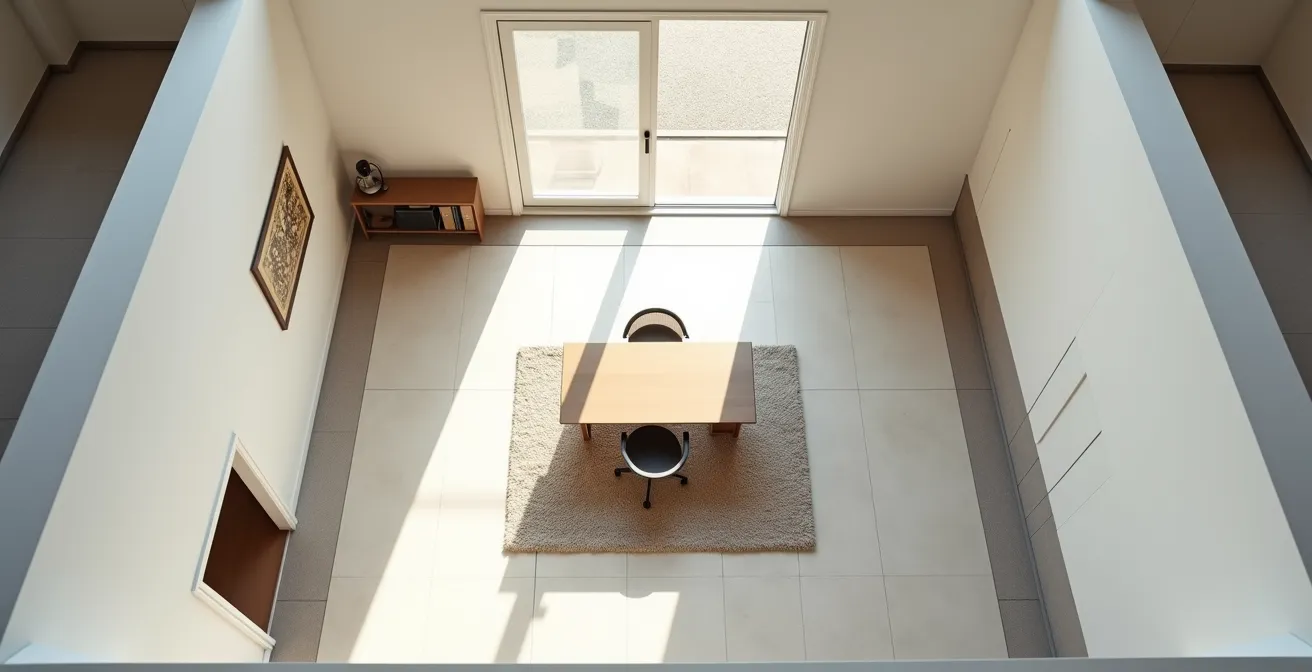
Once you’ve identified your main noise pathways, you can allocate your budget strategically. Focus your resources on the surface that will give you the biggest reduction in distractions first, rather than spreading your efforts too thin. A single, well-treated window is more effective than three poorly treated walls.
Your Action Plan: The Budget-Based Priority Guide
- Under $50 (The Highest ROI Start): Focus entirely on air gaps. Apply high-quality acoustic weatherstripping around your office door frame and install a solid, slide-on door sweep at the bottom. This single step targets the most common weakness.
- Under $200 (Tackle the Window): If outside noise is the problem, invest in window solutions. This could be a set of acoustic-rated curtains combined with proper sealing, or even better, a custom-fit acrylic window insert.
- Under $500 (Treat the Primary Wall): If the noise is coming from an adjacent room, now is the time to treat that shared wall. Add a set of 4-6 high-density acoustic panels or a layer of Mass Loaded Vinyl (MLV) behind a large tapestry.
- $1000+ (Full Room Treatment): At this level, you can combine all the above. A fully treated room involves sealed doors and windows, acoustic panels on the primary reflection points, a thick rug with an acoustic underpad, and potentially even ceiling treatment for impact noise.
Why Your Heavy Curtains Aren’t Blocking the Street Noise?
You invested in heavy, “soundproof” curtains, but the wail of sirens and the drone of traffic still cut through. The reason is simple: a curtain, no matter how thick, cannot defy physics. To block sound, you need two things curtains lack: mass and an airtight seal. While heavy fabric can absorb a small amount of high-frequency echo *within* the room, it does little to stop low-frequency sound energy from passing *through* the window assembly.
The real culprit is the window itself—a thin, vibrating surface—and the air gaps around it. Sound is lazy; it will always travel the path of least resistance. Your heavy curtain might as well be a piece of paper if sound can simply leak around its edges or vibrate the glass pane directly. A far more effective solution is to create a decoupled barrier. This involves adding a second, separate pane that creates a pocket of dead air. That air gap is a powerful insulator against sound vibration.
For renters, the best way to achieve this is with removable acrylic window inserts. These custom-fit panels press into your existing window frame, creating the crucial air gap. According to window soundproofing specialists, acrylic window inserts can block up to 70% of outside noise, a massive improvement over curtains alone. When you combine this with a properly sealed heavy curtain, you create a powerful two-stage defense.
To make your window treatment truly effective, follow this multi-barrier approach:
- Add Decoupled Mass: Install removable acrylic window inserts. They provide a solid, transparent barrier and create an insulating air gap, which is the most critical element for blocking outside noise.
- Create an Airtight Seal: Don’t just hang your curtains. Use heavy-duty Velcro strips or magnetic tape along the sides and bottom of the curtain to seal it directly against the wall, preventing sound from leaking around the edges.
- Address Flanking Paths: Apply peel-and-stick weatherstripping to the window frame itself, especially on older windows, to stop sound from bypassing your primary barriers through small cracks.
- Layer for Absorption: Finally, hang your heavy, dense curtains over the sealed window insert. The insert blocks the noise, and the curtain absorbs any remaining reflections within the room.
How to Mount Acoustic Panels Without Ruining Your Wall Paint?
So, you’ve decided to treat your room’s echo and reverberation with acoustic panels—an excellent choice for improving call clarity and reducing in-room noise. But the thought of drilling multiple holes or peeling off paint is a non-starter in a rental. Fortunately, the market for reversible acoustic solutions has matured, offering several ingenious methods to mount panels without a single drop of spackle needed upon move-out.
The key is to match the mounting method to the panel’s weight and your wall’s surface. Lightweight foam panels can often be held with simple adhesive strips, but heavier, more effective fabric-wrapped fiberglass panels require more robust solutions. Forget nails and screws; think in terms of adhesion, suspension, and freestanding structures. This approach treats your acoustic panels less like permanent fixtures and more like modular art pieces you can position for maximum effect and take with you when you leave.

Freestanding solutions, like using a rolling garment rack or building a simple frame, offer the ultimate flexibility. They allow you to create a portable “acoustic micro-zone” around your desk that you can move as needed. For wall mounting, modern adhesive strips are surprisingly strong, but it’s crucial to use the right type and follow the removal instructions precisely to avoid paint damage.
To choose the best non-destructive method, consult this comparison based on real-world tests for renter-friendly offices.
| Method | Weight Capacity | Wall Damage | Best For |
|---|---|---|---|
| Freestanding Panels on Racks | Unlimited | None | Renters, temporary setups |
| Suspension Wire System | Up to 50 lbs total | 2 small screw holes | Lightweight panels, high ceilings |
| Heavy-Duty Velcro Strips | 10-15 lbs per panel | Minimal if removed properly | 2×2 ft panels on smooth walls |
| 3M Command Strips | 7-10 lbs per panel | None if removed correctly | Small panels on painted walls |
High-Pile Rug or Wall-to-Wall Carpet: Which Dampens Voice Echo Better?
Hardwood or laminate floors are an acoustic nightmare. They are large, flat, reflective surfaces that cause sound waves—especially the frequencies of the human voice—to bounce around endlessly. This creates echo and reverberation, making you sound like you’re in a cave on video calls. The obvious solution is to cover the floor, but does that mean you need wall-to-wall carpet? For a renter, the answer is a definitive no. A well-chosen area rug can be just as effective, if not more so, while offering far greater flexibility.
The effectiveness of a floor covering depends on two factors: its absorption coefficient (how much sound it soaks up) and its coverage area. A high-pile or shag rug made from dense wool or synthetic fibers is excellent at trapping mid-to-high frequency sound waves. When paired with a thick, felt or rubber acoustic underpad, its performance can rival that of many standard carpets. The underpad adds crucial mass and a second layer of absorption.
The key is size. To make a real impact on room echo, acoustic specialists recommend covering at least 40% of the floor space, ideally centered in the room to capture the primary reflection points between you, your speakers, and the ceiling. A home office case study confirmed this, showing that a thick area rug covering the majority of the floor, combined with an underpad, delivered significant acoustic benefits.
Case Study: The Flexible Acoustic Rug
A home office setup in a room with hardwood floors demonstrated that combining a thick area rug covering 70-80% of the floor with a dedicated acoustic underpad achieved nearly identical echo dampening to low-pile wall-to-wall carpet. This renter-friendly solution dramatically improved video call quality by eliminating the “cavernous” sound, but retained the flexibility to be removed or repositioned. The key was the combination of the high-pile rug for absorption and the dense underpad for an extra layer of insulation.
Ultimately, a large, high-pile area rug with a quality underpad is the superior choice for a renter. It provides the necessary acoustic dampening to control voice echo while remaining a flexible, non-permanent design element.
Key Takeaways
- Prioritize action over perfection: Sealing a door gap is a better first step than saving up for expensive panels.
- Think in layers: No single product is a magic bullet. Combine mass (to block) with absorption (to soften) for the best results.
- Your ears are your best tool: Use the “Noise Detective” method to identify your specific noise problem before spending any money.
Why Fixed Furniture Makes Small Rooms Feel 30% Smaller?
The furniture in your office does more than just hold your computer and books; it plays a major role in the room’s acoustics and its perceived size. Large, hard, and immovable pieces of furniture—like a solid wood desk pushed against a wall or a heavy credenza—can be acoustically detrimental. They create large, parallel reflective surfaces that cause “flutter echo,” a rapid, ringing reverberation that makes a room sound harsh and feel smaller. Research suggests that rooms with fixed, hard-surfaced furniture creating flutter echo can make spaces feel up to 30% smaller.
The solution is to think of your furniture as part of your acoustic management system. Instead of fixed, monolithic pieces, opt for modular and movable items. A desk on casters, a rolling bookshelf, or even a simple room divider can be used to break up parallel surfaces and create temporary “acoustic micro-zones.” This approach gives you the power to adapt your environment on the fly, repositioning barriers to shield you from a noise source that may only be active for part of the day.
This concept was tested in a home office study where modular furniture was used not just for flexibility, but for acoustic control.
Case Study: Acoustic Zoning with Modular Furniture
A study of various home office setups found that workers who used movable room dividers and modular furniture could create temporary “acoustic micro-zones” around their desks. One effective setup used a rolling cart with acoustic panels attached, forming a portable sound barrier that could be repositioned based on where noise was coming from. This flexible approach not only improved sound quality for calls but also made the small 12×12 ft room feel more spacious and adaptable compared to static, fixed furniture arrangements.
By choosing furniture that is soft, irregular in shape, or easily movable, you turn static objects into dynamic acoustic tools. A plush armchair absorbs more sound than a wooden one. An open-backed bookshelf filled with books of varying sizes diffuses sound far better than a solid cabinet door.
How to Improve Indoor Air Quality in a Bedroom With Poor Ventilation?
You’ve done it. You’ve sealed the door, treated the window, and added absorption. The room is finally quiet. But now, it feels stuffy, and you might even have a slight headache. This is the soundproofer’s paradox: the very act of sealing a room to keep noise out also traps pollutants in. By stopping air leaks, you’ve also stopped natural ventilation, causing a build-up of CO2 from your own breath, and Volatile Organic Compounds (VOCs) off-gassing from furniture and electronics.
Achieving a quiet workspace cannot come at the expense of your health. A balanced approach is essential. A case study on this exact problem found that weatherstripping a room could decrease natural air exchange by as much as 60%. The most effective solution was two-fold: introducing mechanical ventilation and masking remaining noise.
Case Study: The Soundproofing-Ventilation Balance
In one office, sealing the door and windows reduced noise by 40% but also decreased air exchange significantly. The solution was installing a low-noise air purifier operating at just 28 dB. This served two purposes: it circulated and cleaned the air, reducing CO2 and VOC levels, while also generating a consistent, low-level white noise. This beneficial sound masked remaining sound intrusions, leading to reports of both better focus and fewer headaches.
Therefore, a healthy soundproofing strategy must include a ventilation plan. This doesn’t mean undoing all your hard work. It means incorporating smart solutions that maintain air quality without reintroducing noise.
- Choose Low-VOC Materials: When buying acoustic panels, opt for those made from natural materials like cotton denim insulation instead of synthetic foams, which can release more chemicals into your sealed environment.
- Install a Quiet Air Purifier: This is the single best investment for a sealed room. Look for models that operate under 30 decibels on their low setting, providing both clean air and beneficial white noise.
- Create a “Breathing Schedule”: Make it a habit to open the door and a window for 10-15 minutes every 2-3 hours. This is enough to completely reset the air in the room without disrupting your entire workday.
- Monitor Your Air: For those serious about health, a simple CO2 monitor can be an invaluable tool. It will tell you exactly when the air quality is declining and it’s time to ventilate.
Start by applying the ‘Noise Detective’ method today to identify your primary noise source. This single step is the most effective starting point for reclaiming your focus and engineering a more peaceful workspace.