A profitable no-till transition is not about enduring yield loss; it’s an engineering problem focused on reallocating operational savings to finance the switch from the very first season.
- Mitigate the initial yield drag by maintaining fertility and starting with soybeans, which are less sensitive to transition stress.
- Fund essential planter upgrades and cover crop seed by capturing immediate savings from reduced fuel, labor, and precision fertilizer application.
Recommendation: Treat the transition as a business plan. Model your input cost savings and reinvest them strategically into the equipment and inputs that de-risk the first 24 months.
The biggest barrier to adopting no-till isn’t agronomy; it’s the fear of a multi-year yield dip that could cripple your farm’s cash flow. Every coffee shop conversation is filled with stories of a neighbor who tried it and saw yields plummet for three straight years. The conventional wisdom is to simply “be patient” and “wait for the soil to heal.” For a 1,000-acre operation with thin margins and high fixed costs, waiting three years for profitability is not a strategy—it’s a bankruptcy plan. This fear is rational and based on a fundamental misunderstanding of the transition process.
Many guides focus on the long-term ecological benefits, like improved soil structure or water retention. While true, these don’t pay the bills in year one. The key is to reframe the entire transition. Stop thinking of it as an agronomic sacrifice and start treating it as a project in profitability engineering. The money you save on fuel, machinery wear, and labor from day one isn’t just a bonus; it’s the capital you must actively reinvest to solve the short-term challenges of residue management, cover crop termination, and nutrient availability.
But what if the entire premise of an unavoidable 3-year loss is flawed? What if, with the right strategy, you could engineer a profitable transition from the outset? The solution lies not in enduring the dip, but in using targeted strategies and a clear-eyed business approach to bypass it entirely. It requires shifting focus from yield alone to total system ROI, where input savings become a powerful tool to manage risk.
This guide provides a business-oriented roadmap for that transition. We will dissect the causes of yield drag, analyze the critical equipment and crop choices, and lay out the financial trade-offs to help you build a system that pays for itself, starting now.
Summary: A Practical Guide to a Profitable No-Till Transition
- Why Yields Often Drop for 3 Years Before Rebounding in No-Till?
- How to Plant Through Heavy Corn Stalks Without Jamming the Planter?
- Roller Crimper or Herbicide: Which Terminates Rye Better for Soybeans?
- The Wet Field Mistake That Ruins No-Till Soil Structure Forever
- Which Crop to Start With: Corn or Beans for the Transition Year?
- Why Over-Fertilization Costs You $50 Per Acre Despite Good Yields?
- Why Introducing Beavers (or Mimics) Restores Water Tables Faster?
- How to Increase ROI on Corn Crops Using Precision Ag on Less Than 500 Acres?
Why Yields Often Drop for 3 Years Before Rebounding in No-Till?
The infamous three-year yield drop is not a myth, but it’s also not an inevitability. It’s a biological process that can be managed with a business mindset. The primary culprit is a phenomenon known as the “carbon penalty.” When you stop tilling and introduce high-carbon residue like a cereal rye cover crop, soil microbes feast on this new food source. To break down the carbon, they need nitrogen, which they temporarily pull from the soil, making it unavailable to your cash crop. This nitrogen tie-up is what causes the pale, stunted growth and the resulting yield drag.
Conventional wisdom tells you to wait it out. A business-oriented approach, however, treats this as a predictable nutrient deficiency. You wouldn’t plant a crop in a field you know is deficient in N-P-K without a plan. The transition is no different. The key is to maintain fertility levels, especially nitrogen, during the first few years to feed both the soil microbes and the crop. This isn’t about “over-fertilizing”; it’s about budgeting for the temporary increase in nitrogen demand.
As an example of this profitability engineering, a group of Ohio farmers successfully avoided the yield slump entirely. Their strategy, documented in a case study on profitable no-till transition strategies, involved two key actions. First, they maintained their standard fertility program during the initial years. Second, they used Variable Rate Technology (VRT) to optimize those inputs. The money saved on historically over-fertilized zones was reallocated to fund cover crop seed and planter upgrades. They didn’t just survive the transition; they made it profitable by managing it as a system, not a sacrifice.
This approach transforms the carbon penalty from a yield-sapping problem into a manageable operational expense, one that is offset by savings in other areas like fuel and labor. By understanding the biology, you can replace a passive, three-year waiting game with an active, first-year management strategy.
How to Plant Through Heavy Corn Stalks Without Jamming the Planter?
One of the first and most visible challenges in a no-till system is dealing with heavy residue from the previous crop, especially corn stalks. A conventional planter is simply not designed to slice through a thick mat of tough, damp residue, leading to jammed units, poor seed placement, uneven emergence, and ultimately, a picket-fence stand that looks more like a collection of stragglers. This single mechanical failure can doom a transition before it even begins.
Success here is not about brute force; it’s about surgical precision. Your planter must be modified to perform four distinct jobs in a single pass: clear a path, cut the remaining residue, place the seed at the correct depth, and close the furrow. Investing in a brand-new no-till planter isn’t always necessary; a retrofit of your existing planter is often the most cost-effective first step. The goal is to create a clean, consistent seed trench, regardless of the residue on top.
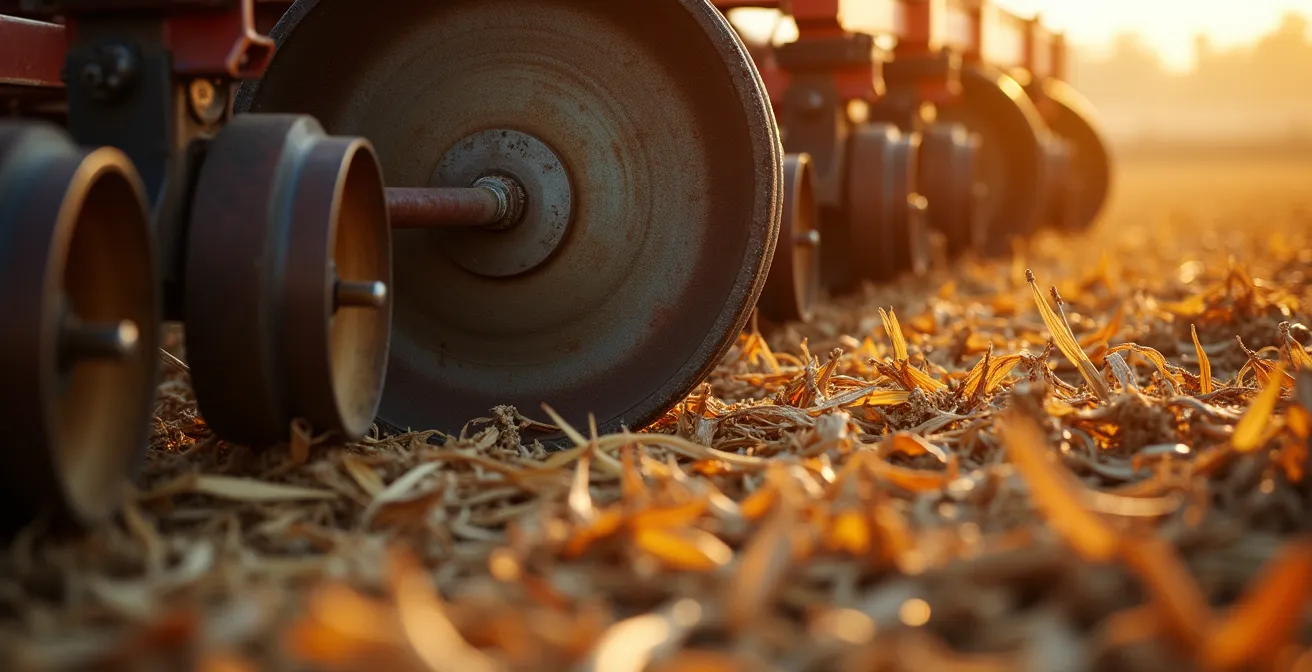
As the image above shows, the interaction between the planter’s components and the residue is critical. The following equipment modifications are non-negotiable for planting into heavy corn residue:
- Row Cleaners: These are the first line of attack. Floating or fixed row cleaners mounted ahead of the main opener discs physically move the bulkiest residue out of the path of the seed trench.
- Sharp Cutting Coulters: After the path is cleared, a sharp, heavy-duty coulter is needed to slice cleanly through any remaining stalks and root balls. A dull or undersized coulter will hairpin residue into the furrow, ruining seed-to-soil contact.
- Sufficient Down-Pressure: No-till requires more down-pressure to penetrate firm, undisturbed soil. Hydraulic systems are superior as they provide instant and consistent pressure, but spring systems can work if properly maintained and set.
- Appropriate Closing Wheels: Standard rubber closing wheels are often ineffective in heavy residue. Spiked or notched closing wheels are needed to crumble the sidewall of the seed trench and ensure it’s properly closed without becoming compacted.
- Stripper Headers: A more advanced, system-level approach involves using a stripper header during harvest. This leaves the stalks standing and attached to the soil, making them easier for the planter to navigate between, rather than planting into a dense, flat mat.
These modifications are a capital expense, but one that should be funded by the operational reallocation of savings from fuel and tillage passes. Skipping this step to save money is a false economy that will cost you dearly in lost yield.
Roller Crimper or Herbicide: Which Terminates Rye Better for Soybeans?
Once you’ve solved how to plant through residue, the next critical decision is how to manage your cover crop. For soybeans planted into a cereal rye cover, the termination method directly impacts weed control, soil moisture, and your budget. The two primary choices are a chemical burndown with herbicide or a mechanical termination with a roller crimper. This isn’t a purely agronomic decision; it’s a strategic choice with significant long-term economic consequences.
An herbicide burndown is the default for many transitioning farmers. It’s familiar, relatively inexpensive per acre in the short term, and offers a wide window for application. However, it’s a recurring annual expense and provides no long-term weed suppression benefit beyond the initial kill. It also misses the opportunity to build the very soil biology that makes no-till profitable in the long run. A roller crimper, on the other hand, is a capital investment. It terminates the rye by breaking its stems, creating a thick, weed-suppressing mat that can last well into the growing season. This mat also conserves soil moisture and provides a slow-release food source for microbes.
This table, based on information from an analysis of organic no-till systems, breaks down the business case:
| Factor | Roller Crimper | Herbicide |
|---|---|---|
| Initial Cost | $15,000-30,000 purchase or $50/acre custom | $15-25/acre chemical cost |
| Timing Flexibility | Must wait for anthesis (narrow window) | Wider application window |
| Weed Suppression | Excellent physical mat barrier | Good initial kill, no mat benefit |
| Soil Biology Impact | Beneficial – feeds microbes | Potentially harmful to soil life |
| Long-term Economics | Break-even Year 2-3 if owned | Recurring annual expense |
The biggest challenge with the roller crimper is timing. It’s only effective when the rye has reached the anthesis (pollination) stage. Crimping too early will result in the rye bouncing back and competing with your soybeans. This requires more management skill than a simple spray pass. However, the long-term ROI is compelling. Over time, the improved weed control and soil health can lead to significant savings. Indeed, long-term studies indicate that by 2025, farms using integrated systems of cover crops and no-till are projected to match or exceed the yields of conventional systems, largely due to these synergistic benefits.
The Wet Field Mistake That Ruins No-Till Soil Structure Forever
There is one mistake in a no-till transition that is nearly irreversible: sidewall compaction from planting into wet soils. In a conventional tillage system, you can get away with working ground that’s a little “tacky” because your next tillage pass will likely shatter any compaction you create. In no-till, there is no next tillage pass. When a planter’s disc openers slice through wet, clay-type soil, they smear the sides of the seed furrow, creating a polished, impenetrable wall. The seedling’s roots can’t penetrate this wall and instead grow horizontally down the furrow, a condition known as “root-pruning” or “tomahawk roots.”
This single error permanently damages the soil structure in the root zone, restricting access to water and nutrients for that season and potentially for years to come. It is the fastest way to turn a promising no-till field into a yield-disaster. The temptation to get in the field and “get it done” is immense, especially when the calendar is closing in. This is where discipline and objective measurement must override impatience. Your eyes can deceive you; the soil surface might look dry, but the crucial zone two to four inches down can be saturated.
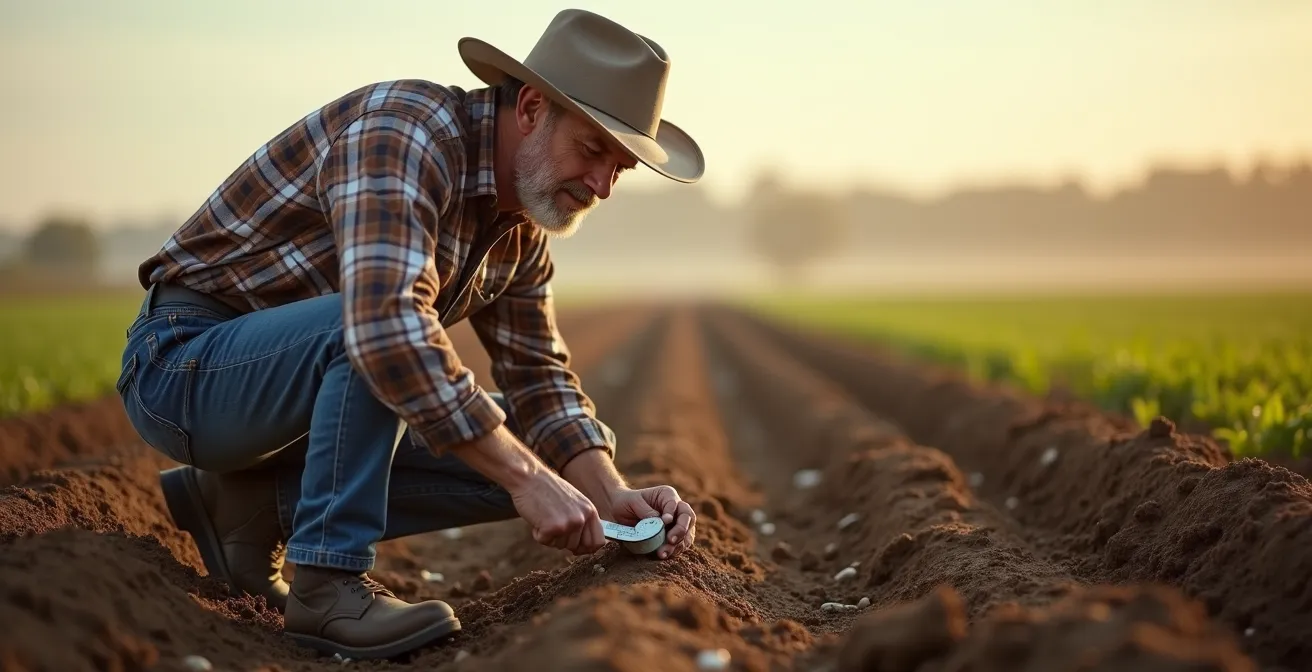
Adopting a strict field entry protocol is the most important risk management strategy you can implement. It moves the decision from a gut feeling to a data-driven process. The goal is to ensure the soil is friable—meaning it crumbles when pressure is applied, rather than smearing or forming a ribbon.
Your Action Plan: Field Entry Protocol for No-Till
- Establish a Threshold: Use a soil penetrometer to establish an objective baseline for compaction. Decide on a maximum PSI reading (e.g., 300 PSI) above which you will not enter the field with heavy equipment, no matter the date.
- Perform the Ribbon Test: Dig down to planting depth and take a handful of soil. Squeeze it in your palm. If you can form a continuous ribbon longer than two inches, the soil is too wet for planting operations. It should crumble easily.
- Implement the 48-Hour Rule: As a general rule, wait at least 24 to 48 hours after a significant rain event (e.g., more than half an inch) before even beginning to assess field conditions.
- Manage Tire Pressure: When you do enter the field, reduce the tire pressure on your tractor and planter to the lowest safe operating level, typically between 15-20 PSI, to maximize the tire’s footprint and distribute the weight.
- Have a “Plan B” for Repair: If compaction does occur, the only “fix” is biological. Plan to use a cover crop mix with deep-rooting species like tillage radish or sorghum-sudangrass in the fall to create biological channels that help break up the compacted layer over time.
Patience in the spring is the most valuable input in a no-till system. Ruining your soil structure for a season—or longer—for the sake of a few days on the calendar is a catastrophic business decision.
Which Crop to Start With: Corn or Beans for the Transition Year?
For a row-crop operation, the first major strategic decision is which crop will lead the transition. While it may seem like a 50/50 choice, the data and on-the-ground experience overwhelmingly point to one clear winner for de-risking year one: soybeans. Starting your no-till transition with soybeans instead of corn is a powerful risk management tool that aligns with a business-first approach.
Corn is a nitrogen-hungry grass that is highly sensitive to the “carbon penalty” and nitrogen tie-up discussed earlier. It is also more vulnerable to the seedling diseases and cool, wet soils common in a high-residue environment during the initial transition phase. Soybeans, on the other hand, are a legume. They produce their own nitrogen, making them far more resilient to the temporary nitrogen deficiency in the soil. They are also more forgiving of a less-than-perfect seedbed.
The data strongly supports this strategy. A global meta-analysis data reveals that while corn can experience a yield decline of 10-20% in the first year of no-till, oilseeds like soybeans and cotton often show no yield decline at all. Starting with soybeans allows your soil system to begin adapting and building aggregates without the immediate and intense nutritional demands of a corn crop, smoothing the transition curve.
The business case is just as compelling. A split-field transition strategy study shows that farms starting with soybeans see immediate benefits. They report 30-50% reduced labor requirements and machinery savings of $10-15 per acre in the first year. The strategy is simple: transition a portion of your acreage to no-till starting with soybeans. After a few years, once the system stabilizes, yields typically increase by 5-10% compared to conventional tillage. This allows you to learn the system on a more forgiving crop while immediately capturing cost savings.
Why Over-Fertilization Costs You $50 Per Acre Despite Good Yields?
In conventional systems, a common mantra is “feed the crop.” This often leads to applying a little extra fertilizer as insurance, especially nitrogen. While this may produce good yields on paper, it creates hidden costs and biological damage that are antithetical to a successful no-till system. In no-till, the mantra shifts to “feed the soil.” Over-applying synthetic fertilizers, particularly anhydrous ammonia, has a biocidal effect, killing the very soil microbes, fungi, and earthworms you are trying to cultivate. This prolongs the transition period and makes your system dependent on expensive inputs.
The cost is not just biological; it’s financial. Applying a uniform rate of fertilizer across a variable field means you are by definition over-applying in some areas and under-applying in others. Those over-applied zones represent a direct hit to your bottom line, often costing upwards of $50 per acre in wasted product, with zero corresponding yield benefit. This wasted capital is the exact money that should be funding your transition through “operational reallocation.”
The Ohio farmers mentioned earlier demonstrated this principle perfectly. According to the case study on their profitable transition, they used Variable Rate Technology (VRT) to apply nutrients only where they were needed. The savings generated from eliminating over-application on their most fertile zones were substantial enough to pay for their entire cover crop seeding program for the year. They turned a hidden expense into the funding mechanism for building a more resilient, profitable system.
This is just one source of savings. The switch to no-till unlocks others. By eliminating tillage passes, USDA research demonstrates that farmers can save over 4,160 gallons of diesel fuel annually per 1,000 acres, a direct cost reduction of over $8,500. When you combine fuel, labor, and precision fertilizer savings, you generate significant capital that can and must be reinvested into the system.
Why Introducing Beavers (or Mimics) Restores Water Tables Faster?
As your no-till system matures, typically in years three through five, you can begin to focus on “Phase 2” optimizations. One of the most powerful long-term benefits of a healthy no-till system is its dramatically improved water infiltration and retention. Healthy soil with abundant earthworm burrows and root channels acts like a sponge, absorbing heavy rains instead of letting them run off. This “in-field” water storage becomes a form of natural sub-irrigation during dry spells.
A more advanced strategy for maximizing water resilience is to look at the landscape level, particularly at marginal or less productive acres. Here, mimicking the work of beavers by installing low-tech, process-based restoration structures like beaver dam analogs (BDAs) or swales can have a profound effect. These structures slow the flow of water across the landscape, forcing it to spread out and seep into the ground. This recharges shallow aquifers and can raise the local water table, providing a critical buffer during flash droughts.
This is not a year-one priority. It is an optimization for a mature system. Nebraska farmer Marlin Murdoch, who has been practicing no-till since the 1980s, exemplifies this evolution. As documented in a USDA case study on drought resilience, his long-established no-till fields already had superior water infiltration. By later adding strategic water retention structures, he further enhanced his farm’s ability to withstand drought, reducing irrigation costs and ensuring crop survival when neighbors were failing.
Implementing such a system requires a phased, long-term approach. It’s about identifying the right land and the right time to invest in these landscape-level improvements.
- Years 1-2: Focus exclusively on mastering in-field no-till practices. Build soil structure, manage residue, and stabilize the system.
- Year 3: Use yield maps and soil surveys to identify marginal or consistently wet acres that are suitable for water retention projects.
- Year 4: Research and apply for federal cost-share programs, such as the USDA’s NRCS EQIP, which can often fund a significant portion of these restoration projects.
- Year 5 and beyond: Begin the installation of low-tech structures and monitor their impact on sub-irrigation benefits and water availability during summer dry spells.
This strategy transforms water from a resource to be drained and discarded into a valuable asset to be captured, stored, and used to build long-term farm resilience.
Key takeaways
- The 3-year yield drag is not mandatory; it’s a manageable “carbon penalty” that can be offset with a strategic fertility plan.
- Reallocating savings from fuel and labor is essential to fund the necessary planter upgrades for handling heavy residue.
- Starting the transition with soybeans is a proven risk-management strategy that leverages the crop’s natural resilience and lower nutrient demands.
How to Increase ROI on Corn Crops Using Precision Ag on Less Than 500 Acres?
The principles of profitability engineering are not just for large-scale operations. For farms under 500 acres, precision agriculture technology is often the key to unlocking the ROI of a no-till system, especially for a demanding crop like corn. The goal is to use technology to make smarter, more targeted decisions that cut waste and boost efficiency. This isn’t about buying every new gadget; it’s about making targeted investments with a clear and rapid return.
For a smaller-acreage corn operation transitioning to no-till, the focus should be on technologies that directly address the biggest variable costs: fertilizer and seed. The idea that precision ag is too expensive for smaller farms is outdated. Many technologies offer a payback period of just one to two seasons, making them a powerful tool for managing transition-year cash flow. The ability to precisely control inputs allows you to fund the transition with the savings you generate in real time.
This table, derived from a breakdown of precision ag tools, highlights the most impactful technologies for a no-till corn transition:
| Technology | Cost Range | ROI Timeline | Primary Benefit |
|---|---|---|---|
| VRT Fertilizer | $15-25K upgrade | 1-2 seasons | 30% input reduction |
| Section Control | $8-12K | 1 season | 5-8% seed savings |
| NDVI Monitoring | $500-2000/year | Immediate | Targeted rescue applications |
| Yield Mapping | $5-8K | 2-3 seasons | Zone management data |
For a farm of 500 acres or less, the quickest ROI often comes from planter section control. By eliminating overlap on headlands and point rows, it can generate 5-8% seed savings, often paying for itself in a single season. The next step is Variable Rate Technology (VRT) for fertilizer. This stops you from over-applying expensive nitrogen in areas that don’t need it, freeing up capital that can be used to address other transition challenges. Together, these tools allow you to manage a no-till corn system with a level of precision that maximizes profitability, regardless of acreage.
Ultimately, a successful transition to no-till is a function of management, not magic. By treating it as a business plan—analyzing costs, managing risk, and making strategic capital investments funded by operational savings—you can build a more resilient and profitable farming system without suffering through years of financial loss.