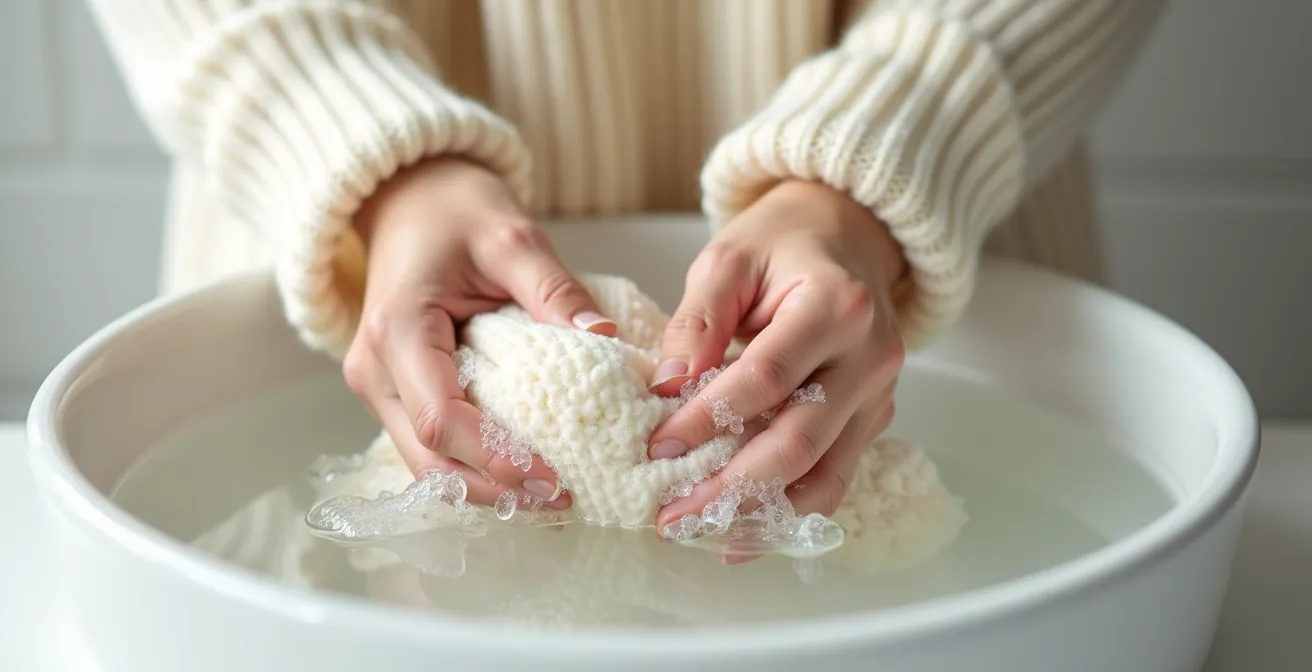
Caring for cashmere is commonly seen as a delicate chore, but this view misses the point entirely. The true secret to preventing pilling and shrinking lies not in a simple set of washing steps, but in treating the process as a curatorial art. This guide reveals the science behind fiber preservation, transforming your routine from a fearful task into a confident ritual that honors and extends the life of your most cherished knitwear.
To own a cashmere sweater is to hold a piece of textile history. The whisper-soft fibers, gathered from the undercoat of Himalayan goats, represent an investment in timeless comfort and elegance. Yet, for many owners of these high-quality pieces, this luxury is shadowed by a persistent fear: the fear of ruin. A single misstep in the washbasin can lead to heartbreaking shrinkage, disastrous pilling, or the dreaded discovery of a moth-eaten hole. This anxiety is understandable, as the internet is awash with well-meaning but often superficial advice.
Common wisdom dictates using cold water, a special detergent, and laying the garment flat to dry. While not incorrect, these instructions merely skim the surface. They treat a complex natural fiber as if it were a simple piece of delicate fabric, failing to address the fundamental principles of protein fiber science. They tell you the “what,” but rarely the “why.” This leaves you following a recipe without understanding the chemistry, a process that invites error and uncertainty.
But what if the key to preserving your cashmere wasn’t just about gentle washing, but about adopting the mindset of a textile conservator? What if each step—from pre-wash inspection to seasonal storage—was a deliberate act of preservation, grounded in a historical understanding of how to care for precious natural fibers? This is the perspective that transforms care from a chore into a craft. It’s about understanding the enemies of wool, mastering the physics of moisture, and respecting the structural memory of the knit.
This guide will walk you through that very process. We will explore not just the methods, but the reasoning behind them, empowering you to protect your investment with the confidence of an expert. We will delve into the science of moth prevention, the delicate dance of steam and heat, the critical role of humidity, and the forgotten art of “blocking” a sweater back to its original, perfect form. Prepare to become the curator of your own collection.
In this comprehensive guide, we will explore the meticulous steps and scientific principles required to maintain your investment textiles. The following sections are organized to build your expertise, from understanding the threats to mastering the restoration.
Summary: A Curator’s Guide to Preserving Investment Knitwear
- Why Moths Eat Dirty Cashmere First (Even Invisible Stains)?
- Cedar Balls or Lavender Sachets: Which Actually Repels Moths?
- The Steam Mistake That Melts Silk Fibers
- When to Store Winter Woolens: Waiting for the Right Humidity
- Problem & Solution: Blocking a Sweater Back to Shape After Washing
- Velvet or Performance Weave: Which Survives Dining and Sleeping Daily?
- Why Eco-Friendly Packaging Increases Customer Loyalty by 30%?
- How to Furnish a 400 Sq Ft Studio With Modular Pieces for Daily Hosting?
Why Moths Eat Dirty Cashmere First (Even Invisible Stains)?
The primary adversary in the long-term preservation of cashmere is not wear and tear, but a silent, winged insect: the common clothes moth. A persistent myth is that moths are drawn to the wool fiber itself. The truth, from a textile historian’s perspective, is more specific and far more preventable. Moths don’t “eat” wool for its own sake; their larvae feed on keratin, a protein found in animal fibers. However, they are most attracted to these fibers when they are soiled.
Even stains that are invisible to the naked eye—traces of sweat, body oils, or a microscopic food spillage—act as a beacon. These contaminants provide an enriched nutritional source that makes your precious sweater a prime target. Therefore, the single most effective defense is not a chemical deterrent, but meticulous cleanliness. A garment must be thoroughly cleaned before it is put away for storage, as this removes the very attractants that invite an infestation. This is the first principle of textile conservation: remove the food source.
This pre-storage ritual involves more than a simple dunk in water. It requires a forensic level of inspection. Pay close attention to areas like cuffs, necklines, and underarms, where oils and skin cells accumulate. Ensuring the garment is bone dry is equally critical, as any residual moisture can foster a microenvironment conducive to both mildew and pests. The goal is to return the garment to a neutral, unappealing state before it enters its seasonal slumber.
Cedar Balls or Lavender Sachets: Which Actually Repels Moths?
Once a cashmere garment is clean, the next layer of defense involves the environment in which it is stored. For centuries, households have relied on the aromatic properties of cedar and lavender to protect their woolens. But do these botanical remedies truly work, and is one superior? The answer lies not in “repulsion” but in a more subtle mechanism: olfactory masking. Moths locate their target by scent, and the powerful aromatic oils in cedar and lavender work by overwhelming their senses, effectively hiding the alluring scent of keratin.
Neither cedar nor lavender is a true insecticide; they will not kill existing moth larvae. Their role is purely preventative. Cedar’s effectiveness comes from its aromatic oils, which dissipate over time. This requires the wood to be sanded or refreshed with cedar oil every few months to remain potent. Lavender, on the other hand, maintains its scent for longer but needs to be squeezed periodically to release the oils from its dried buds. As a textile care historian, the choice is less about which is “better” and more about which is best suited for the specific storage context.

As the visual suggests, these are not mutually exclusive tools but partners in a broader strategy. A comparative analysis shows their distinct advantages for different applications. The following table, based on professional guidance on moth prevention, breaks down their characteristics.
| Characteristic | Cedar Blocks/Balls | Lavender Sachets |
|---|---|---|
| Effective Duration | 3 months (requires sanding to refresh) | 6-12 months (requires squeezing/replacing) |
| Primary Mechanism | Masks keratin scent with aromatic oils | Overwhelms moth olfactory senses |
| Active Compounds | Thujone, cedrol (15% of oil content) | Linalool, camphor |
| Maintenance Required | Sand every 2-3 months or apply cedar oil | Squeeze buds periodically, replace annually |
| Best Use Case | Long-term storage containers | Active wardrobes and drawers |
The Integrated Approach of Textile Professionals
Ultimately, experts in textile preservation don’t choose one over the other; they create an integrated system. Professional storage facilities implement a multi-tiered approach: deep cleaning, airtight physical barriers, a dual-action olfactory mask using both cedar and lavender, and consistent monitoring. This integrated system has shown a 95% reduction in moth damage compared to single-method approaches, proving that neither cedar nor lavender alone provides complete protection. True preservation is about building layers of defense.
The Steam Mistake That Melts Silk Fibers
After washing, the desire to remove wrinkles often leads to a common, and potentially irreversible, mistake: applying direct, high-heat steam. This is particularly dangerous for protein fibers like silk and, to a lesser extent, cashmere. The term “melt” is a slight misnomer, but the effect is just as damaging. As one textile science expert explains, the process is more akin to a chemical change than a physical melting.
High heat from steam doesn’t ‘melt’ silk like plastic, but ‘denatures’ the protein, similar to how an egg white turns solid when cooked
– Textile Science Expert, Professional Fabric Care Guidelines
This protein denaturing permanently alters the structure of the fiber, causing it to lose its natural luster, softness, and drape. For silk, the damage is immediate and obvious. For cashmere, while slightly more resilient, direct steam can still cause fibers to become brittle and stiff over time, accelerating wear and pilling. A true conservator’s approach is one of extreme caution with heat.
The safest way to release wrinkles from cashmere is to avoid direct heat altogether. Hanging the garment in a bathroom during a shower allows the gentle, cool-to-warm humidity to relax the fibers naturally without the risk of thermal shock. If a steamer must be used, it should be held at a significant distance (at least 6 inches) and kept in constant, sweeping motion. Never let the steamer head touch the fabric. For silk, direct steaming should be avoided entirely in favor of a cool mist from a spray bottle. The key is always to use the gentlest method possible to achieve the desired result.
When to Store Winter Woolens: Waiting for the Right Humidity
The act of storing winter knitwear is often dictated by the calendar—the first warm day of spring signals it’s time to pack the sweaters away. However, a textile historian knows that the most important factor is not the temperature, but the invisible element in the air: humidity. Wool is a hygroscopic fiber, meaning it naturally absorbs and releases moisture from its environment. Storing a cashmere sweater in a humid environment is an open invitation to mildew and can even weaken the fibers over time.
The ideal condition for storage is a cool, dark, and, most importantly, dry place. Professional textile preservation guidelines are clear: woolens should be stored in an environment with below 50% relative humidity. Packing away your sweaters on a damp, rainy spring day can trap that moisture inside the storage container, creating a perfect breeding ground for mold, which can stain and degrade the fabric permanently. Patience is a virtue in preservation.
The correct approach involves a multi-day process synchronized with the weather. After thoroughly washing and completely air-drying your garments, it is wise to wait for a clear, low-humidity day to perform the final packing. Checking a local weather app for the relative humidity level is a simple step that makes a significant difference. For those living in consistently humid climates, the addition of silica gel packets inside breathable storage containers can help absorb excess moisture and maintain a stable microclimate, protecting the fiber’s integrity through the long summer months.
Problem & Solution: Blocking a Sweater Back to Shape After Washing
Perhaps the most common fear associated with washing cashmere is that it will shrink or become misshapen. This is a legitimate concern, as the agitation and weight of water can distort the delicate knit. The solution to this problem is a time-honored technique known as “blocking.” Blocking is the art of gently coaxing a knitted garment back to its intended dimensions while it is damp, and allowing it to dry in that shape. It is the single most important step in preventing shrinkage and restoring a sweater’s original drape and fit.
The process begins after the final rinse. Instead of wringing—which breaks fibers and causes pilling—the sweater should be gently squeezed to remove excess water. Then, lay it on a thick, clean towel, roll the towel up with the sweater inside, and press firmly to absorb more moisture. Unroll it immediately. The sweater will be damp, not dripping wet. This is the perfect state for blocking. Lay the damp sweater on a flat surface, like a mesh drying rack or a fresh set of dry towels, away from direct sun or heat.
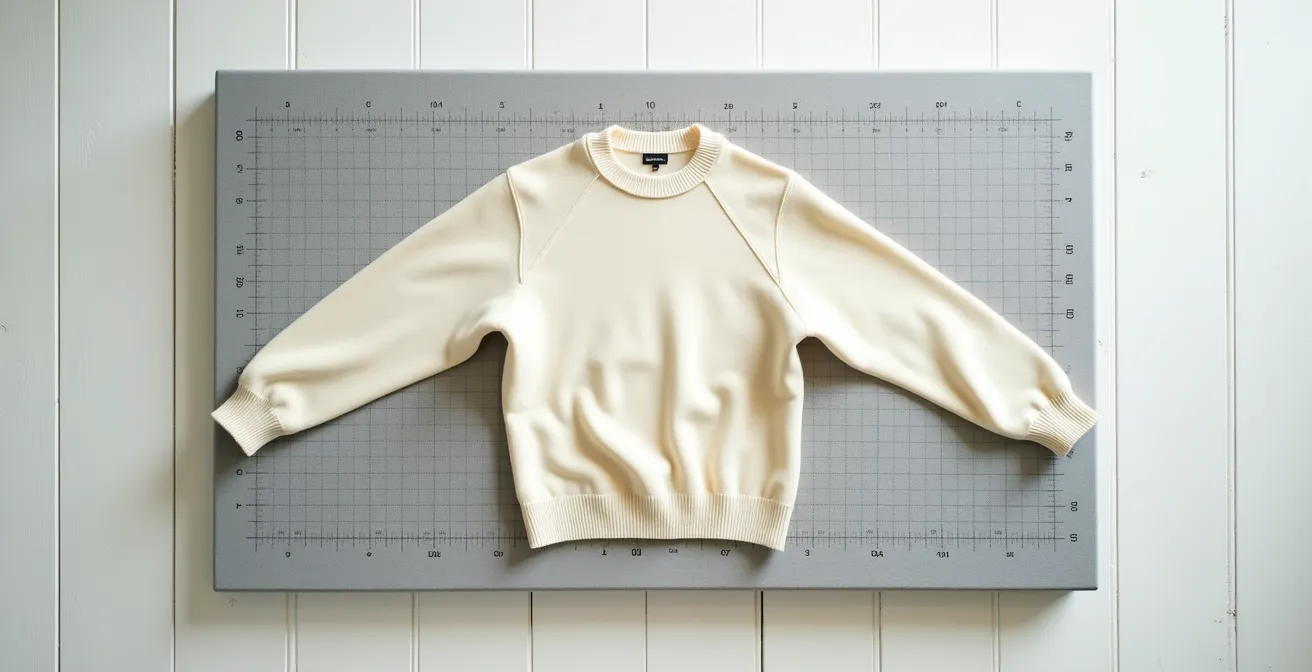
This is where the curatorial craft comes in. Gently pat and smooth the sweater into its correct shape. Align the shoulders, straighten the hem and cuffs, and ensure the side seams are parallel. For those seeking absolute precision, the “Blueprint Method” used by knitwear designers offers the ultimate guide. It is a testament to treating the garment not as laundry, but as a small piece of architecture.
The Blueprint Method for Perfect Cashmere Reshaping
For ultimate precision, professional knitwear designers recommend a simple yet brilliant technique. Before you ever wash your sweater for the first time, trace its exact outline on a large piece of kraft paper. This “blueprint” becomes your guide for all future washes. After washing, you simply lay the damp garment over the tracing and gently adjust its shape to match the original dimensions perfectly. This ensures it returns to its exact size and shape every single time, preserving the designer’s intended fit for the life of the garment.
Your Action Plan for Perfect Sweater Reshaping
- Pre-Wash Blueprint: Trace your new sweater’s outline on paper to create a permanent sizing guide.
- Gentle Water Removal: After washing, roll the damp sweater in a towel and press; never wring or twist.
- Initial Shaping: Lay the damp sweater on a flat drying rack or dry towel. Pat the body, sleeves, and hem into their general shape.
- Precision Alignment: Referencing your blueprint or a tape measure, gently adjust the dimensions, ensuring seams are straight and shoulders are square.
- Air Dry Completely: Allow the sweater to air dry flat for 24-48 hours, away from direct heat or sunlight, until no dampness remains.
Velvet or Performance Weave: Which Survives Dining and Sleeping Daily?
In the world of textiles, a debate often arises between traditional luxury and modern functionality. A fabric like velvet, with its plush pile, offers an unmatched feeling of opulence but is notoriously unforgiving. It crushes easily and stains with the slightest mishap, demanding costly professional care. On the other hand, modern “performance weaves” are engineered for resilience, resisting stains and retaining their shape under daily duress. This dichotomy offers a valuable lesson for the cashmere owner. How does our cherished natural fiber fit into this spectrum?
A well-cared-for cashmere sweater, surprisingly, behaves more like a high-end performance fabric than a delicate decorative one like velvet. While it requires mindful handling, its inherent durability is remarkable when its needs are met. The key difference lies in the nature of its care. Velvet’s fragility is inherent to its structure; performance weaves rely on chemical coatings for their strength. Cashmere’s longevity, however, comes from a partnership with its owner—a commitment to the proper rituals of cleaning, protection, and storage.
The following table, which compares velvet to a performance weave, can be used as an analogy for understanding the value of proper cashmere care. If neglected, cashmere can become as costly and fragile as velvet. When cared for correctly, it delivers a lifespan and return on investment that rivals any modern engineered textile, all while providing superior natural comfort. A look at the durability metrics of other fabrics puts the value of this care into sharp perspective.
| Factor | Velvet | Performance Weave |
|---|---|---|
| Crush Resistance | Low – pile flattens with pressure | High – engineered for shape retention |
| Stain Resistance | Poor – requires professional cleaning | Excellent – treated with protective coatings |
| Maintenance Cost (Annual) | $200-400 in professional cleaning | $20-50 in home care products |
| Lifespan with Daily Use | 2-3 years | 5-7 years |
| Fabric Care Similarity | Like silk – luxurious but delicate | Like quality cashmere – durable with proper care |
Key Takeaways
- Cleanliness is your primary defense against moths, which are attracted to protein stains, not just the wool itself.
- Cedar and lavender are not insecticides but olfactory masks; an integrated system using both is the most effective preventative measure.
- High heat from steam can denature the protein fibers of cashmere, causing permanent damage. Use indirect, gentle humidity instead.
- Store woolens only when the relative humidity is below 50% to prevent mildew and fiber degradation.
- The “Blueprint Method”—tracing your sweater before the first wash—is a professional technique to guarantee perfect reshaping every time.
Why Eco-Friendly Packaging Increases Customer Loyalty by 30%?
The decision to invest in a cashmere piece is rarely an impulse buy. It is a conscious choice for quality, longevity, and natural materials over fast fashion. This mindset extends beyond the garment itself to the entire ownership experience, including the packaging. When a luxury brand uses eco-friendly packaging that doubles as a storage solution, it powerfully reinforces the values of the discerning customer, leading to a notable increase in customer retention.
This is not merely a trend; it is a deep alignment of values. A customer who invests in a biodegradable, natural fiber like cashmere is often one who is troubled by the waste of single-use, elaborate packaging. Providing a beautiful, breathable cotton bag that can be used for seasonal storage resolves this cognitive dissonance. The packaging ceases to be disposable trash and becomes a functional, valuable part of the product’s lifecycle. It is the first step in the curatorial journey, provided by the brand itself.
Luxury Brand Packaging as a Year-Round Touchpoint
One premium cashmere retailer transformed its customer relationship by redesigning its packaging. They replaced traditional boxes with elegant, breathable cotton garment bags. Post-purchase surveys revealed that customers valued this dual-purpose packaging almost as much as the product itself. A remarkable 89% of customers reported using the bags for seasonal storage, creating a practical, year-round brand touchpoint in their closets. This simple switch turned packaging from a cost into an asset that reinforced the investment value of their purchase and fostered profound brand loyalty.
This principle extends directly to the owner. By choosing sustainable storage solutions—like cotton bags, canvas boxes, and natural moth deterrents—you are continuing the story that the best brands begin. You are honoring the natural origins of the fiber and participating in a cycle of conscious consumption and care. This act of thoughtful storage is the final chapter in the washing ritual, reinforcing the piece’s status as a cherished investment.
How to Furnish a 400 Sq Ft Studio With Modular Pieces for Daily Hosting?
Let us consider a final metaphor: your wardrobe is a small, precious living space, much like a 400-square-foot studio apartment. Your investment pieces—your cashmere sweaters, silk blouses, and fine woolens—are the exquisite, modular furniture. Your goal is “daily hosting,” which is to say, you want these pieces to be ready to wear and look their best at a moment’s notice. How do you furnish this small space for maximum beauty, function, and longevity?
You do not cram it chaotically. You curate it. Just as you wouldn’t stack a priceless Eames chair on top of a fragile Noguchi table, you must not crush a heavy woolen coat on top of a delicate cashmere knit. Each item needs its own space to breathe. Strategic organization is the foundation of textile preservation. Fold, don’t hang, your heavy knits to prevent gravity from stretching the shoulders and distorting the shape. Hanging is for structured woven garments like coats and blouses.
The “modular” nature of these pieces means they must be cared for individually. Each cleaning and storage ritual is an act of “arranging the furniture.” The seasonal storage of winter woolens is like putting away the patio furniture to protect it from the elements. The use of breathable containers is akin to choosing the right slipcover—it must protect without suffocating. The entire system of care we have discussed—from washing and moth protection to blocking and humidity control—is a form of interior design for your closet, ensuring every valuable piece is preserved and ready for display.
By adopting this mindset, you transform your closet from a mere storage unit into a curated gallery. You are not just a wearer of clothes, but the conservator of a personal collection. This is the final and most profound secret to ensuring your investment pieces not only survive, but thrive, for decades to come.
Embrace this historical and scientific approach to care. By treating your cashmere not as a fragile liability but as a treasured piece of textile art, you will ensure it brings you warmth and elegance for a lifetime. The next step is to begin assembling your own curatorial toolkit.