Travel & Discovery
The world of travel has fundamentally transformed over the past decade. What was once limited to brief vacations or gap years has evolved into a sustainable lifestyle for millions who work remotely while exploring the globe. Yet this freedom brings complex questions: How do you navigate tax obligations across multiple countries? How can you document your experiences in ways that go beyond typical tourist snapshots? Understanding these dual dimensions—the practical logistics of location-independent living and the art of meaningful visual storytelling—defines modern travel and discovery.
This comprehensive resource addresses both the administrative realities and creative opportunities that define contemporary travel. Whether you’re planning your first extended journey abroad or refining years of nomadic experience, the intersection of legal compliance and artistic expression shapes how you experience and share the world. From establishing tax residency to capturing heritage sites without crowds, these interconnected skills empower you to travel with both confidence and purpose.
Why Digital Nomadism Requires Strategic Financial Planning
The romantic vision of working from Balinese cafes or Portuguese coastal towns often overlooks a critical reality: your tax obligations don’t disappear when you leave your home country. In fact, they become considerably more complex. The concept of tax residency determines where you owe taxes, and this status depends on multiple factors including physical presence, economic ties, and documented intentions.
Most countries apply a threshold of approximately 183 days of physical presence to establish tax residency, though this varies significantly. Some nations claim taxation rights based on citizenship regardless of location, while others focus purely on where you spend the majority of your time. Without careful planning, you risk either paying taxes in multiple jurisdictions simultaneously or, conversely, being considered a tax resident nowhere—a status that creates complications when opening bank accounts, signing contracts, or demonstrating financial legitimacy.
The Center of Vital Interests Framework
When the 183-day rule proves ambiguous or you split time relatively evenly between locations, tax authorities examine your center of vital interests. This legal concept evaluates where your strongest personal and economic connections exist. Factors include property ownership, family location, professional affiliations, and even social memberships. A freelance designer might physically reside in Thailand for seven months but maintain such strong ties to Germany—through property, business registration, and family—that German authorities could legitimately claim tax residency.
Understanding this framework helps you make intentional decisions rather than accidentally creating tax exposure. If you maintain an apartment lease, driver’s license, and gym membership in your passport country while traveling, you’re building evidence of continued residency there, even during extended absences.
Navigating Visa Schemes and Double Taxation
The recent proliferation of digital nomad visas has created new opportunities and complexities. Countries from Portugal to Costa Rica now offer specific visa categories for remote workers, each with distinct tax implications. Some schemes exempt foreign-sourced income from local taxation for specified periods, while others grant residency permits without addressing tax status at all—leaving you responsible for understanding the distinction.
Double taxation treaties between countries provide relief mechanisms, typically through tax credits or exemptions. However, these agreements vary dramatically in structure and coverage. The treaty between your citizenship country and your residence country may handle employment income differently from investment returns or rental income. Successfully preventing double taxation requires documenting your residency status, maintaining records of taxes paid in each jurisdiction, and often consulting with tax professionals familiar with international arrangements.
Social Security Contributions Across Borders
Beyond income taxes, social security systems present additional challenges. When you work across multiple countries, each nation’s social insurance scheme may claim contributions for healthcare, unemployment, and retirement benefits. The European Union’s coordination regulations allow workers to remain in their home country’s system while temporarily working elsewhere in the bloc, but similar protections rarely exist outside regional agreements.
Digital nomads often face a difficult choice: continue voluntary contributions to their home country’s social system while receiving no immediate benefits abroad, or accept gaps in coverage that could affect future retirement calculations or healthcare access. Some establish residency in countries with favorable self-employment social contribution rates, though this requires genuine tax residency rather than simply obtaining a visa.
The Art and Technique of Travel Photography
While navigating tax obligations keeps your travels legally sustainable, photography transforms experiences into lasting memories and shareable stories. Yet the most photographed locations on Earth present a paradox: how do you create meaningful images when millions have already captured the same scenes? The answer lies not in finding undiscovered places, but in approaching familiar subjects with technical skill, creative vision, and strategic timing.
Strategic Planning for Heritage Sites
Photographing iconic landmarks without crowds requires understanding human patterns as much as camera settings. Popular heritage sites experience predictable flow patterns throughout the day. Most tourists arrive mid-morning after breakfast, creating peak congestion between 10 AM and 2 PM. Late afternoon sees another surge as day-trippers make final visits before dinner. These patterns leave two optimal windows: early morning during the first hour after opening, and the final hour before closure when most visitors have departed.
Beyond daily timing, weekly and seasonal patterns matter enormously. Weekend crowds often triple weekday numbers at urban landmarks. Cultural sites near cruise ports experience massive influxes on ship arrival days, while remaining relatively quiet between sailings. Researching these patterns before arrival allows you to sequence visits strategically, photographing the most popular locations during their quietest periods while saving lesser-known sites for peak times.
Technical Approaches for Distinctive Images
When some crowd presence proves unavoidable, technical solutions can minimize or eliminate people from your compositions. Long exposure photography uses extended shutter speeds—typically 10 to 30 seconds or longer—to render moving people as ghostly blurs or remove them entirely while keeping stationary architecture sharp. This technique requires a sturdy tripod and neutral density filters to reduce light entering the camera, allowing longer exposures even in daylight.
Lens selection fundamentally shapes perspective and composition. Wide-angle lenses (14-35mm) emphasize foreground elements and create dramatic spatial relationships, perfect for architectural interiors or landscapes where you want to convey scale. However, these lenses also exaggerate crowds, making sparse groups appear larger. Telephoto lenses (70-200mm or longer) compress perspective, isolating specific architectural details while naturally excluding peripheral crowds from your frame. A 200mm lens trained on a cathedral’s rose window excludes the hundreds of tourists below, creating an intimate detail shot impossible with wider focal lengths.
Developing Creative Vision Beyond Clichés
The most widely shared photos of famous landmarks—the Eiffel Tower from Trocadéro Gardens, Machu Picchu from the Guardian House—become compositional clichés precisely because they work. These viewpoints capture the subject’s essence effectively. Moving beyond them requires intentional creativity: changing your elevation by climbing nearby hills or accessing rooftops, isolating unexpected details rather than capturing entire structures, or incorporating foreground elements that frame the subject uniquely.
Weather and light transform familiar scenes dramatically. Most tourists photograph landmarks under clear blue skies, but dramatic storm clouds, fog, or twilight conditions create mood and atmosphere impossible in harsh midday sun. Arriving before sunrise or remaining after sunset accesses light quality that simply doesn’t exist during normal visiting hours. The same monument photographed under stormy skies with long exposure creates an entirely different emotional impact than the standard postcard view.
Integrating Legal Compliance and Creative Practice
These two dimensions of travel and discovery—managing international tax obligations and creating meaningful photographic work—might seem entirely separate, but they share fundamental principles. Both require advance planning rather than reactive problem-solving. Both benefit from understanding systems and patterns that aren’t immediately obvious to casual observers. And both transform travel from consumption into intentional practice.
The digital nomad who tracks their location carefully, maintains proper documentation, and times their international moves around tax year boundaries demonstrates the same strategic thinking as the photographer who researches crowd patterns, arrives at optimal times, and uses technical skills to overcome obstacles. Neither approach happens accidentally; both require education, preparation, and consistent execution.
As you develop your travel practice—whether you’re planning your first extended journey or refining years of experience—consider how these practical and creative elements reinforce each other. The administrative foundation of proper tax planning provides freedom from anxiety about legal complications. The creative fulfillment of meaningful photography transforms experiences into lasting value. Together, they define what modern travel and discovery can become: not escape from responsibility, but intentional engagement with both the world’s beauty and its complexity.
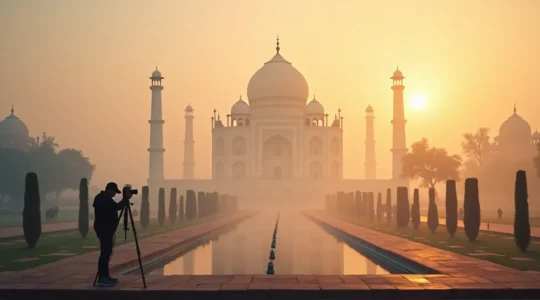
How to Photograph the Taj Mahal Without Thousands of Tourists in the Frame?
Getting a clean shot of the Taj Mahal is not about luck; it’s a multi-layered logistical operation that systematically removes crowds through planning, gear, and technique. Strategic timing and entry point selection are more critical than any other factor. Mastering…
Read more
How to Establish Tax Residency in a Low-Tax Jurisdiction While Traveling?
Successfully establishing tax residency is not a simple checklist of destinations, but a strategic severing of old fiscal ties and forging of new, defensible ones. The “183-day rule” is a common trap; your “center of vital interests,” including personal and…
Read more